
Compliance Article
The Importance of Being Earnest
By Mark Jenkins, Managing Director
“Earnestly and in good faith.” That is the DOJ’s standard for a functioning compliance program. The DOJ requires your compliance program to be implemented earnestly. Unfortunately, no one thought to tell the chatbot.
A language model that has never had a conviction, a belief, or a stake in anything cannot be earnest in either sense of the word. AI has no faith. It has no convictions, no institutional memory, no stake in whether your program holds up under scrutiny. It will draft your anti-corruption policy with the same indifference it uses to write a grocery list.
The Investigator Reads Differently Than the Model Does
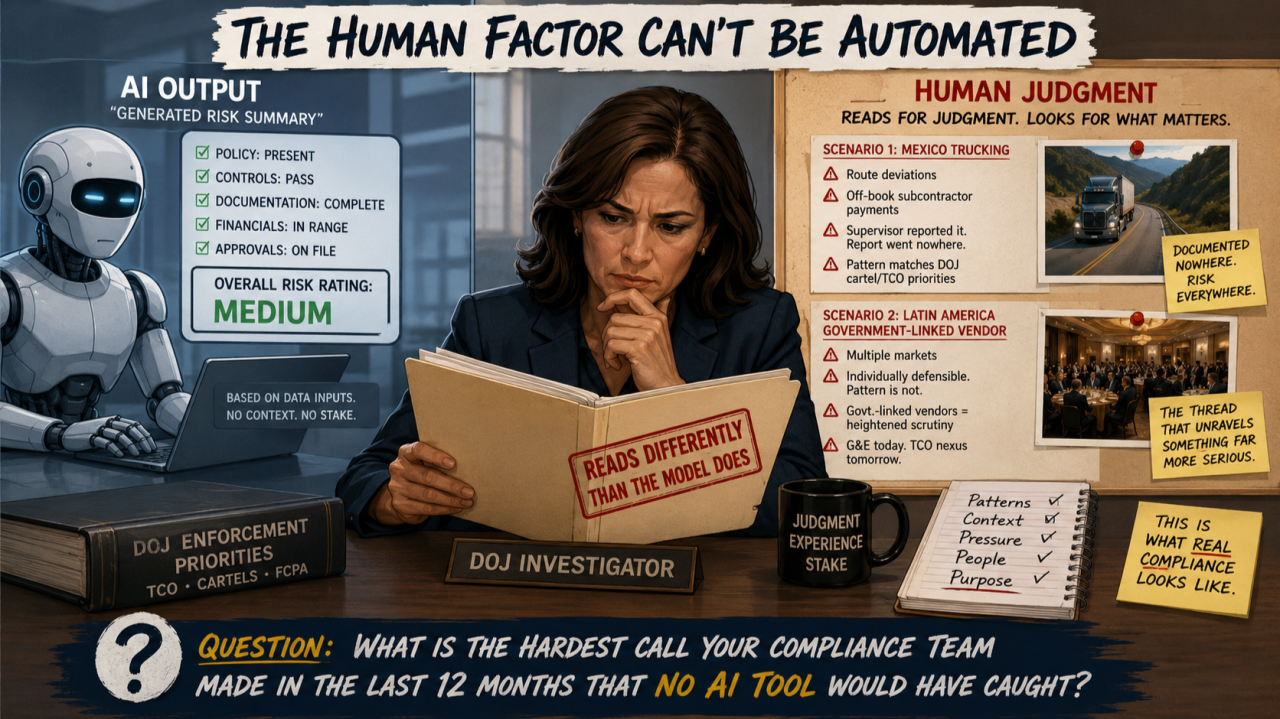
Picture a seasoned DOJ attorney reviewing your third-party due diligence file. She is not checking whether the right words appear in the right fields. She is reading for judgment — did someone in your organization actually think about this? Did they push back, ask hard questions, flag the thing that looked wrong even when the numbers were fine?
Scenario 1
Mexico Trucking
A freight supervisor flags anomalous route deviations and off-book subcontractor payments to local haulers near a contested corridor. He files a report. It goes nowhere. An AI-generated risk summary rates the third party “medium” because the financial controls passed a checklist. The investigator reading that file in 2026 recognizes the pattern immediately: undocumented routes, local subcontractor pressure, a supervisor too cautious to say what he sees in writing. That is exactly the fact pattern DOJ is pursuing under its current cartel and TCO enforcement priorities. Material support exposure to a designated Foreign Terrorist Organization does not resolve with a fine. It resolves with an indictment. The model flagged nothing because it had no stake in what the facts meant.
The Quiet Scenario Is the More Dangerous One
Scenario 2
Latin America Government-Linked Vendor
A Latin America regional manager approves a series of payments to a government-linked event vendor across three markets. The amounts are individually defensible. The pattern is not. An experienced compliance officer in this environment knows that government-linked vendors in the region now carry a heightened scrutiny burden precisely because DOJ has made TCO nexus a primary FCPA enforcement consideration. What presents as a gift and entertainment issue may be the thread that unravels something far more serious. The investigator sees it. The model sees average transaction size and a completed approval form.
The Program That Survives Looks Different
It is built on what your last investigation actually taught you — the specific pressure points in West Africa construction, the margin dynamics in Southeast Asia logistics, the way pharma HCP speaker fees get approved in markets where your legal team is one time zone away. That institutional knowledge does not live in a model. It lives in people who understand what they are protecting and why.
“The challenge is not whether AI belongs in your compliance program. It does. The challenge is whether the judgment layer is real.”
Whether there is someone who reads a file the way a DOJ attorney would — before the DOJ attorney does.
For Your Team
What is the hardest call your compliance team made in the last 12 months that no AI tool would have caught?

Work with Us
Your Program Needs a Judgment Layer
Schulz Trade Consulting helps organizations build compliance programs that hold up under DOJ scrutiny — not just on paper, but in practice.