Tag: compliance

  • The Importance of Being Earnest

    The Importance of Being Earnest

    The Importance of Being Earnest

    By Mark Jenkins, Managing Director


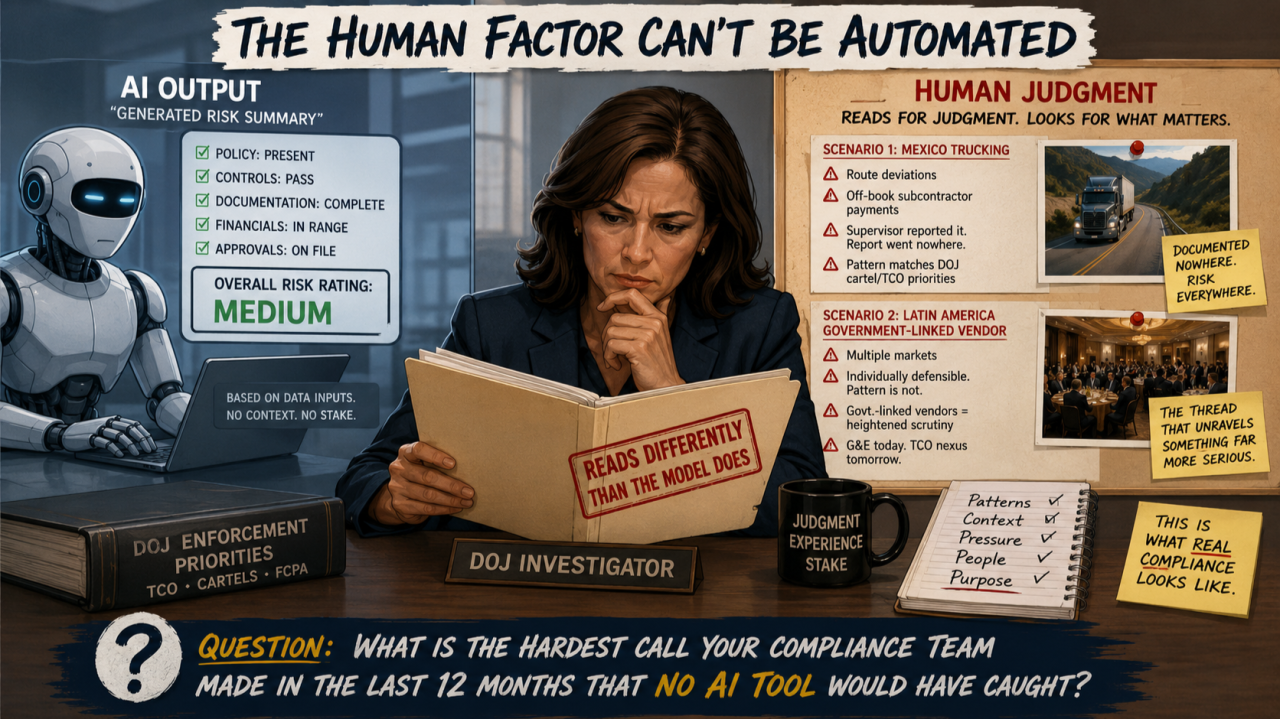
    “Earnestly and in good faith.” That is the DOJ’s standard for a functioning compliance program. The DOJ requires your compliance program to be implemented earnestly. Unfortunately, no one thought to tell the chatbot.

    A language model that has never had a conviction, a belief, or a stake in anything cannot be earnest in either sense of the word. AI has no faith. It has no convictions, no institutional memory, no stake in whether your program holds up under scrutiny. It will draft your anti-corruption policy with the same indifference it uses to write a grocery list.

    The Investigator Reads Differently Than the Model Does

    Picture a seasoned DOJ attorney reviewing your third-party due diligence file. She is not checking whether the right words appear in the right fields. She is reading for judgment — did someone in your organization actually think about this? Did they push back, ask hard questions, flag the thing that looked wrong even when the numbers were fine?

    Mexico Trucking

    A freight supervisor flags anomalous route deviations and off-book subcontractor payments to local haulers near a contested corridor. He files a report. It goes nowhere. An AI-generated risk summary rates the third party “medium” because the financial controls passed a checklist. The investigator reading that file in 2026 recognizes the pattern immediately: undocumented routes, local subcontractor pressure, a supervisor too cautious to say what he sees in writing. That is exactly the fact pattern DOJ is pursuing under its current cartel and TCO enforcement priorities. Material support exposure to a designated Foreign Terrorist Organization does not resolve with a fine. It resolves with an indictment. The model flagged nothing because it had no stake in what the facts meant.

    The Quiet Scenario Is the More Dangerous One

    Latin America Government-Linked Vendor

    A Latin America regional manager approves a series of payments to a government-linked event vendor across three markets. The amounts are individually defensible. The pattern is not. An experienced compliance officer in this environment knows that government-linked vendors in the region now carry a heightened scrutiny burden precisely because DOJ has made TCO nexus a primary FCPA enforcement consideration. What presents as a gift and entertainment issue may be the thread that unravels something far more serious. The investigator sees it. The model sees average transaction size and a completed approval form.

    The Program That Survives Looks Different

    It is built on what your last investigation actually taught you — the specific pressure points in West Africa construction, the margin dynamics in Southeast Asia logistics, the way pharma HCP speaker fees get approved in markets where your legal team is one time zone away. That institutional knowledge does not live in a model. It lives in people who understand what they are protecting and why.

    “The challenge is not whether AI belongs in your compliance program. It does. The challenge is whether the judgment layer is real.”

    Whether there is someone who reads a file the way a DOJ attorney would — before the DOJ attorney does.

    What is the hardest call your compliance team made in the last 12 months that no AI tool would have caught?

  • Holiday Spending Hits Records — But Consumers Are Taking Home Less

    Holiday Spending Hits Records — But Consumers Are Taking Home Less

    Michelle Schulz on KSL Radio

    Holiday Spending Hits Records — But Consumers Are Taking Home Less

    Michelle Schulz Explains Why Tariffs Are Driving Up Prices

    Trade attorney Michelle Schulz breaks down how tariffs on more than 70 countries, shifting rules, and the end of the de minimis threshold are pushing up prices on toys, clothing, decorations—and even small online orders.

    Inside Sources, KSL Radio

    Salt Lake City, Utah

    Host: Holly Richardson

    Record Spending, Smaller Shopping Carts

    On KSL Radio, hosts opened with a surprising contrast: despite record-breaking Black Friday and Cyber Monday numbers, shoppers are bringing home fewer goods. Prices rose faster than spending — and international trade attorney Michelle Schulz explained why.

    “We’ve got tariffs on over 65 countries — I’m thinking it’s over 70 now,” Schulz said. “The tariffs impact a wide variety of industries… and clients who are importers are really struggling to deal with them and either cover the cost or pass it along to their buyers.” 

    Even though consumers feel like everything is “on sale,” the data shows the opposite: shopping carts are smaller and price tags are higher — a direct consequence of multiple layers of tariffs now baked into supply chain costs.

    Toys, Textiles, and Christmas Decorations Are All Going Up

    When asked which holiday goods are being hit hardest, Schulz was clear:

    “Toys are up there — also clothing and textiles… fashion items have always been subject to slightly high tariffs, but it’s more now,” she explained. “People are buying less. They’re paying more, but they’re buying less.” 

    Even Christmas decorations — almost all imported from China — are more expensive this year.

    Adding to the complexity, companies must track which tariffs apply to which components. Is it the metal? The fabric? The finished good? Schulz said the rapid changes are causing unavoidable errors:

    “We’re seeing a lot of mistakes, and I can’t blame them — it’s changing all the time, and it’s difficult to understand how they stack.” 

    Free Trade Agreements vs. Penalties — and the End of the $800 Rule

    The conversation turned to the USMCA agreement. Schulz noted that for some businesses, it has been the only thing saving them:

    “I had a client tell me yesterday that the U.S.–Mexico–Canada Free Trade Agreement saved their year,” she said. “If they hadn’t qualified, they wouldn’t have been able to handle the tariffs.” 

    But not everything qualifies — and attempts to “route” goods through Mexico or Canada without meeting origin rules can backfire.

    “That turns into a major problem with customs… and can result in penalties. Transshipments are currently subject to 40% penalties.” 

    Perhaps the most universal change: The $800 de minimis exemption is effectively gone.

    “There’s no $800 threshold anymore,” Schulz warned. “Even low-dollar items are subject to tariffs now… You may see the tariff in your cart, or you may be surprised afterwards.” 

    Whether you’re importing bulk goods or ordering a $20 toy from overseas, untaxed imports are no longer the norm — and it’s catching consumers off guard.


    schulz trade consulting icon

    Tariffs now touch nearly every category of holiday shopping—from toys to textiles to small online orders—and the rules continue shifting.

    If your business imports goods of any kind, contact Schulz Trade Consulting today to review classification strategies, avoid penalties, and manage rising tariff exposure during the busiest retail season of the year.

  • Consumers Are Feeling the Squeeze: Tariffs, Fashion Prices, and the Supreme Court’s Pending Ruling

    Consumers Are Feeling the Squeeze: Tariffs, Fashion Prices, and the Supreme Court’s Pending Ruling

    Michelle Schulz on SiriusXM POTUS Politics

    Consumers Are Feeling the Squeeze

    Michelle Schulz on Tariffs, Fashion Prices, and the Supreme Court’s Pending Ruling

    Trade attorney Michelle Schulz explains why apparel, electronics, and everyday imports are getting more expensive — and how a Supreme Court decision could trigger billions in refunds.

    POTUS Politics

    SiriusXM, Channel 124

    Host: Tim Farley

    “Companies Are No Longer Able to Absorb the Difference”

    In her latest appearance on SiriusXM POTUS Politics, trade attorney Michelle Schulz said consumers are now directly experiencing the impact of the current tariff regime. Businesses that once buffered the costs are out of room.

    “It has been significant,” she told host Tim Farley. “Companies are no longer able to absorb the difference, and the tariffs are really increasing prices. Consumers are seeing this, and they’re complaining about it.” 

    Schulz highlighted one especially painful shift: the loss of the old $800 de minimis threshold, which once allowed low-value items to enter the U.S. duty-free.

    “We used to be able to import items under $800 and we can’t do that anymore,” she said, noting that the effect has hit fast-fashion, shoes, and electronics particularly hard.

    A Fashion Industry Bracing for 2026 — and Small Businesses Already Breaking

    Farley pointed out that the global fashion sector expects 2026 to be a very difficult year. Schulz agreed — and stressed that small U.S. importers are already in crisis.

    “For the most part… companies are hoping desperately that something will change,” she said. “Small businesses in apparel, footwear, other kinds of fashion are not going to be able to stay in business. We are trying to help them stay in business, but there is only so much you can do when the tariffs are a huge percentage of the import price.” 

    Even large companies with international footprints can only hold out so long. The industry is effectively waiting on the Supreme Court — and running out of time.

    The Supreme Court Decision Could Trigger Refunds — But No Quick Fix

    As the Supreme Court prepares to rule on whether President Trump exceeded his authority under the International Emergency Economic Powers Act (IEEPA), Schulz said the stakes are enormous.

    If the justices find the tariffs unlawful, “there will have to be a refund option,” she said. “

    Importers should be following what they’re paying and tracking their expenses… Customs should be providing refunds. It’s not quick — they’re not quick to return money — but it can be done.” 

    She also noted that the recent federal shutdown caused delays in seizures, inspections, and protests — all of which hit importers with storage fees and carrying costs.

    “The time ends up taking money,” she said.

    But even a ruling against the administration won’t solve supply chain challenges overnight. As Schulz reminded listeners:

    “Overall, there’s no easy way to manage this as a company.”


    schulz trade consulting icon

    With consumer prices rising and the Supreme Court’s decision imminent, importers must prepare for both outcomes: relief in the form of refunds or continued tariff pressure.

    If your business imports apparel, electronics, or other consumer goods, contact Schulz Trade Consulting today to audit your tariff exposure, review refund eligibility, and build a compliance plan that protects your bottom line.

  • Tariffs on Toys and Trucks: Michelle Schulz Explains Why Holiday Prices Keep Rising

    Tariffs on Toys and Trucks: Michelle Schulz Explains Why Holiday Prices Keep Rising

    Michelle Schulz on SiriusXM Road Dog Trucking

    Tariffs on Toys and Trucks:

    Michelle Schulz Explains Why Holiday Prices Keep Rising

    Trade attorney Michelle Schulz joins SiriusXM’s Road Dog Trucking to unpack how shifting tariffs are driving up costs for toys, furniture, and freight—and what that means for consumers and the trucking industry heading into 2026.

    knx los angeles logo

    Road Dog Trucking

    SiriusXM, Channel 146

    Anchor: Mark Willis

    A Pricier Christmas Ahead

    With Thanksgiving around the corner, trade attorney Michelle Schulz, founder of Schulz Trade Law in Dallas, joined Road Dog Trucking News to discuss how tariffs are shaping holiday spending.

    She said consumers can expect to pay noticeably more for gifts this year.

    “Yes, I would say absolutely—you’re looking at over $100 more on average, and it will continue to rise,” Schulz explained. “Although some tariffs have been dialed back, and we have trade deals pending, many tariffs remain in place. They’re high one day, low the next, but still higher than normal overall.”

    She added that even familiar items like furniture and electronics are climbing fast.

    “I was just hearing yesterday from someone that buying furniture became an issue because prices are increasing weekly,” Schulz said. “The closer we get to Christmas, the farther into the tariffs we get.”

    Toys, Tariffs,
    and Sticker Shock

    The toy industry is being hit especially hard.

    “Toys can be made of all different materials subject to tariffs, and they come from countries under tariff,” Schulz noted. “We’re seeing the toy industry really struggle, with fewer imports and more expensive toys this year.”

    She pointed to fads like the Lab Boo Boo plush toy—this year’s hit item—as examples of how small electronic components can push prices higher.

    “It’s the electronics and textiles inside these toys,” she said. “Everything depends on what’s in it, how it’s categorized, and how much it’s valued.”

    Even everyday products like clothing are affected.

    “Textiles are subject to tariffs too,” Schulz added. “Everything that comes in from overseas eventually moves on trucks, and that means these costs ripple through the whole system.”

    Trucking, Delays, and a Tightening Supply Chain

    For the trucking industry, Schulz warned that the ripple effects could be significant.

    “We are seeing customs seizing shipments,” she said. “They’ll detain shipments if they think you’re underpaying, and sometimes those get stuck for months. That means storage fees—thousands of dollars per month in some cases.”

    As tariffs expand and enforcement tightens, Schulz said she expects the slowdown to continue.

    “We’ve reached a deal with China holding out at 10%, but next year it’s scheduled to go up to 34%. Even with delays, these tariffs aren’t going away,” she explained. “Everything from parts to oil and gas is going to cost more—and that directly impacts trucking.”

    Her outlook for 2026: cautious.

    “We’re seeing companies hold off on investments, and even layoffs in some cases,” she said. “This isn’t stopping this year—it’s going to carry through next year.


    schulz trade consulting icon

    From toy manufacturers to trucking fleets, tariff volatility is reshaping every link of the supply chain.

    If your company imports, ships, or distributes goods affected by tariffs, contact Schulz Trade Consulting today to assess your exposure, prevent costly delays, and develop strategies to navigate the year ahead.

  • Tariffs on the Open Road: How Trade Policy Is Hitting Trucking, Retail, and the Holiday Season

    Tariffs on the Open Road: How Trade Policy Is Hitting Trucking, Retail, and the Holiday Season

    Michelle Schulz on WJR Radio, Detroit

    Tariffs on the Open Road

    Michelle Schulz Explains How Trade Policy Is Hitting Trucking, Retail, and the Holiday Season

    As the Supreme Court deliberates on Trump’s tariff authority, trade attorney Michelle Schulz joins SiriusXM’s Road Dog Trucking to discuss how rising duties are driving up prices, tightening inventories, and reshaping the freight economy.

    knx los angeles logo

    Road Dog Trucking

    SiriusXM, Channel 146

    Anchor: Mark Willis

    “Not So Merry” Holiday Outlook

    Speaking with SiriusXM’s Road Dog Trucking News, Dallas-based trade attorney Michelle Schulz warned that the holidays will bring higher prices, fewer deals, and tighter margins across the retail sector.

    “I would say not so merry,” Schulz said. “Prices are going up, and I am planning on higher prices during the Christmas season. We don’t have the Supreme Court ruling on the IEEPA tariffs yet… but we’re already seeing especially high tariffs on countries like India and sectors like shoes and hats—things we buy all the time for Christmas presents.”

    While consumers may still celebrate, Schulz said retailers and importers are struggling.

    “It’s impossible for some of our clients to provide significant cost reductions in this environment,” she explained. “Buyer beware—holiday deals may not be as great this year.”

    Business Belt-Tightening and Industry Whiplash

    Beyond the holidays, Schulz warned that the ripple effects of tariffs are dampening hiring, bonuses, and capital investment.

    “We’re seeing companies tightening their belts, reducing their workforce, not increasing it,” she said. “In every industry—oil and gas, manufacturing, retail—there’s a combination of confusion and fear.”

    She added that even companies with stocked inventory are running out of cushion. “

    It’s getting less and less feasible to eat the cost or negotiate cheaper prices with foreign sellers,” she explained.

    The uncertainty has led to hesitation in investment and production:

    “They’re walking on eggshells. It changes day to day, and even Customs brokers are frustrated—they’re re-evaluating tariff rates constantly, and mistakes are almost inevitable.”

    Trucking, Manufacturing, and the Tariff Chain

    The trucking industry, Schulz noted, is being hit from both sides—by reduced freight volume and by higher equipment costs.

    “We’ll see some trucks a little less full, or combining shipments rather than single loads,” she said. “There are also higher tariffs on certain heavy-duty trucks, so the impact is direct.”

    Even domestic manufacturing isn’t insulated.

    “Any company with metal content in its products is struggling,” Schulz explained. “We’ve had clients using metal detectors in warehouses to find whether there’s steel in something—because it could be subject to a 50% tariff.”

    When callers suggested that tariffs could boost U.S. manufacturing, Schulz agreed in theory but cautioned that globalization runs deep.

    “Manufacturing in the U.S. involves more foreign products than most people would guess,” she said. “We deal with that every day—there’s always one little part that becomes a problem.”


    schulz trade consulting icon

    From importers to truckers, everyone in the supply chain is feeling the tariff strain.

    If your company moves, sells, or manufactures goods impacted by recent tariffs, contact Schulz Trade Consulting today to audit your tariff exposure, review country-of-origin classifications, and develop compliance strategies that protect your bottom line.

  • The Increasing Challenge of Trade Fraud: Strengthening Compliance for Today’s Environment

    The Increasing Challenge of Trade Fraud: Strengthening Compliance for Today’s Environment

    Trade Compliance Corner

    The Increasing Challenge of Trade Fraud

    Strengthening Compliance for Today’s Environment

    The Departments of Justice and Homeland Security have launched a powerful, cross-agency Trade Fraud Task Force that is transforming the enforcement landscape. This signals an unprecedented crackdown on trade fraud—including tariff evasion, product misclassification, and falsification of customs documents. The consequences for companies caught in these schemes have never been more severe or relentless.

    Link: DOJ Article

    increasing challenge of trade fraud

    Real-World Cases Illustrate High Enforcement Risk

    Recent enforcement actions have exposed the prevalence of these fraudulent schemes.

    • Importers have deliberately manipulated customs paperwork to hide the true country of origin and manufacturer, avoiding millions in duties. Many of these cases were uncovered through whistleblower tips revealing complex transshipment and misrepresentation tactics.
    • Some entities blatantly underreported or failed to disclose dutiable imports, only revealing their misconduct after aggressive inquiry or internal investigations forced their hand.
    • False declarations were used to sidestep antidumping and countervailing duties by misclassifying products or providing incomplete information, complicating enforcement efforts and increasing penalties.
    • In other cases, importers unlawfully disguised high-duty items as low-duty goods, exploiting tariff loopholes on sensitive commodities.

    These are not isolated incidents. The volume and sophistication of investigations will only accelerate, with civil and criminal penalties looming large. Whistleblower incentives are encouraging insiders to come forward, increasing exposure for organizations with weak controls or compliance gaps.

    What Compliance Professionals Need to Do — Urgently

    If complacency or weak controls exist, now is the time to act. Here are the must-do compliance strategies to mitigate this escalating threat:

    • Fortify Documentation and Validation: Your supply chain data and claims about product origin must be airtight and able to withstand the toughest regulatory examination. Any ambiguity puts your company directly in the crosshairs.
    • Conduct Aggressive Internal Audits: Regular, comprehensive reviews of customs filings and import data are critical—especially for products and countries flagged as high risk. Catching issues early and self-reporting problems could drastically reduce legal and financial fallout.
    • Invest in Rigorous Training: Your teams need ongoing, detailed guidance about accurate product classification, customs documentation requirements, and the real criminal risks involved with non-compliance.
    • Prioritize High-Risk Transactions: Focus scrutiny on goods subject to heavy tariffs or sourced from countries with known regulatory attention. This is often where violations, deliberate or accidental, are uncovered.
    • Empower and Protect Whistleblowers: Establish secure, trusted channels for internal reporting and enforce zero tolerance for retaliation. Quick escalation and remediation of red flags is key to avoiding catastrophic enforcement actions.
    • Leverage Technology with Oversight: While automated tools can help identify suspicious filings or anomalies, always combine these with expert human review to adapt to ever-evolving scam tactics.

    The DOJ and Homeland Security are dedicating new and significant resources to uncovering and prosecuting trade fraud on a national scale. Compliance programs must evolve from a box-checking exercise into dynamic defense systems designed to detect, deter, and destroy trade fraud schemes—before they deplete your company’s finances and negatively impact your corporate reputation.

    Compliance professionals must lead the charge to build more vigilant, transparent, and proactive controls or face the harsh consequences of an enforcement wave.

  • Is Your Compliance Program Strong Enough for DOJ’s New 2025 Standards?

    Is Your Compliance Program Strong Enough for DOJ’s New 2025 Standards?

    Is Your Compliance Program Strong Enough for DOJ’s New 2025 Standards?

    Schulz Trade Consulting LLC

    by Mark Jenkins, Managing Director, Schulz Trade Consulting LLC

    At the last two compliance conferences, I’ve been asked the same question: What’s new in the Department of Justice’s (DOJ) approach under the new administration? Are they “soft on crime”? The quick answer is “I doubt it” and many caveats are very similar to past administrations. Below is the latest update, crucial for any company hoping to avoid prosecution through compliance and self-reporting.

    May 2025 DOJ Policy Update

    On May 12, 2025, the DOJ’s Criminal Division released an updated Corporate Enforcement and Voluntary Self-Disclosure Policy. This new policy clarifies that only companies that detect, investigate, and remediate problems early—and report first—will qualify for declinations (decisions not to prosecute). The policy replaces the prior “presumption” language with a formal process: qualifying companies can expect actual declination, while “near miss” cases may earn Non-Prosecution Agreements (NPAs) with requirements and transparency. [1]

    Overview of DOJ Guidance

    • Declination of prosecution is available if a company:

    – Voluntarily self-discloses misconduct

    – Fully cooperates with DOJ investigators

    – Undertakes timely and appropriate remediation (see below)

    – Has no severe aggravating factors like recidivism or obstruction

    • Near miss or aggravating cases may receive:

    – Non-Prosecution Agreements (NPAs) with reduced penalties, public disclosures, and no monitor requirement in many cases

    • Transparency: All declinations will be publicly posted and require forfeiture and restitution—even if prosecution is declined
    • Strict definitions: “Full cooperation” and “remediation” are now clearly detailed, including compliance structure and immediate action expectations

    Compliance Takeaways—Appendix: “Timely and Appropriate Remediation”

    The appendix lays out DOJ expectations:

    • Root-cause analysis: Go beyond fixing the problem—address the underlying causes.
    • Compliance program structure: Sufficient resources, independence, authority, quality risk assessments, and board access.
    • Consistent discipline: Accountability at all levels, including management.
    • Modern information controls: Policies on data retention, personal devices, and ephemeral messaging.
    • Regular testing for effectiveness: Routinely evaluate if compliance controls and procedures actually work in practice. Examples include internal audits, compliance program and fraud risk assessments, and adjustment of controls based on real outcomes and evolving risks.
    • Proactive measures: Ongoing risk reduction efforts, not just after-the-fact fixes.

    Early Self-Disclosure Requires a Robust Compliance Program

    To truly benefit from self-disclosure, your compliance program must be capable of detecting and investigating issues internally—before a whistleblower reports straight to the government. DOJ gives a brief window for self-reporting, but you’ll miss it if you’re not monitoring and acting quickly.

    Liberty Mutual Declination Example

    Liberty Mutual recently received a declination from the DOJ by voluntarily disclosing, cooperating fully, and swiftly remediating the underlying issues—with real changes to its compliance program, in line with these new guidelines. If you missed our prior article on Liberty Mutual, see footnote link. [2]

    Bottom line for compliance officers

    The DOJ makes it clear: only organizations with robust, proactive, and regularly tested compliance programs will earn leniency. Waiting until a whistleblower acts is waiting too long.


    [1] For details, see the DOJ’s official update: https://www.justice.gov/criminal/media/1400031/dl?inline

    [2] https://schulztc.com/dont-let-your-compliance-program-collect-dust-lessons-from-liberty-mutual/

  • The Cartel Crisis: Why Compliance Must Act Now

    The Cartel Crisis: Why Compliance Must Act Now

    Anti-Corruption Watch

    The Cartel Crisis: Why Compliance Must Act Now

    By Mark Jenkins, Managing Director

    Schulz Trade Consulting LLC

    In today’s globalized business environment, compliance professionals face increasingly complex and covert threats beyond traditional regulatory risks. Among the most insidious is the infiltration of legitimate corporations by drug cartels and transnational criminal organizations (TCOs). These groups have evolved from mere narcotics traffickers into multifaceted criminal enterprises, embedding themselves through supply chains, vendors, service providers, and even internal personnel.

    Importantly, even major U.S. cities are not immune to cartel activity. In my hometown of Dallas, Texas, for example, three major Mexican drug cartels operate active hubs, underscoring the widespread and deeply entrenched nature of this threat.

    Why Compliance Must Care: Alarming Statistics

    According to the 2025 National Drug Threat Assessment, over 84,000 Americans died from drug overdoses in the year ending October 2024, a crisis fueled by illicit supply chains facilitated in part through legitimate business channels. Investigations have revealed cases where more than $50 million in cartel funds were laundered via U.S. corporations’ subsidiaries and suppliers. Additionally, eight Mexican cartel organizations have been designated by the U.S. government as “foreign terrorist organizations,” significantly increasing legal liability and compliance risk exposure for companies with direct or indirect involvement.

    This data underscores an urgent reality: no corporation, regardless of size or industry, can consider itself immune.


    Increased Enforcement Under the New U.S. Administration

    The current U.S. administration has made combating drug cartels and their transnational criminal networks a law enforcement priority. Recent actions include enhanced sanctions, indictments, and asset seizures against cartel-linked entities and individuals. The expansion of “foreign terrorist organization” designations to multiple Mexican cartels raises the stakes for corporations inadvertently facilitating their operations.

    The Department of Justice has issued public advisories warning businesses that failure to exercise comprehensive due diligence and compliance oversight could result in criminal and civil penalties. This includes the risk of secondary sanctions and prosecution. Compliance professionals must recognize that insufficient investigation or willful blindness to cartel infiltration risks increasingly leads to severe legal consequences and regulatory scrutiny.


    Cartel Infiltration Across Industries

    Food and Beverage:
    A Mexican subsidiary of a multinational beverage company was targeted by violent arson attacks from a cartel after cooperating with law enforcement. More than 30 trucks and warehouses across multiple states were destroyed, underscoring the lengths cartels will go to intimidate multinational supply chains.

    Security Companies:
    Security firms contracted by U.S. subsidiaries in Mexico have been infiltrated by cartel-linked personnel. These individuals have enabled theft, intelligence gathering, and manipulation of security protocols, threatening the physical safety of assets and employees from within.

    Mining Sector:
    Mining companies in Mexico have faced coerced “collaboration agreements” where cartel-linked groups demanded protection payments disguised as community fees. Firms that resisted faced sabotage and threats, disrupting operations and exposing them to criminal networks.

    Logistics and Freight:
    A multinational logistics company uncovered a systematic diversion of electronics and precursor chemicals by cartel-affiliated drivers embedded through subcontractors. This scheme was uncovered through a combination of physical audits and advanced digital transaction monitoring.

    Real Estate and Finance:
    U.S.-based title companies and commercial real estate firms have been fined millions for their role—often unwitting—in laundering cartel proceeds through property transactions tied to cartel-controlled assets near major transport hubs.

    Agriculture:
    Cartels have embedded themselves in produce supply chains. A U.S.-linked poultry processor discovered cartel-linked transport providers using shipping containers for hidden narcotics transport during government investigations.

    Traditional Industries:
    Even staple businesses such as tortilla producers in Mexico are not spared, with cartels exerting extortion and control over operations.

    Red Flags for Compliance Teams

    • Unexplained or irregular payments, particularly through unknown subsidiaries or offshore entities.
    • Vendors or contractors who resist ownership transparency or background checks.
    • Unfamiliar intermediaries facilitating critical deals or contracts.
    • Employees, especially in procurement or security, displaying unexplained affluence or reluctance to rotate roles.
    • Recurring demands disguised as community ‘donations’ or ‘right-of-way’ payments.
    • Resistance to audits or control procedures.
    • Supply chain irregularities, such as inconsistent shipment documentation or unexplained route changes.

    Recognizing these signs early is critical to preventing escalation into operational, legal, and reputational crises.

    Conclusion

    Cartel infiltration represents one of the most complex and serious challenges facing corporate compliance programs today. The documented cases across industries highlight the pervasive and damaging nature of this threat. With the U.S. government’s intensified enforcement efforts and expanding legal liabilities for businesses, compliance professionals must sharply heighten vigilance. Proactive, comprehensive due diligence, combined with strong internal controls and robust employee engagement, is essential to safeguard organizations from catastrophic financial, operational, and reputational harm.

    This knowledge equips compliance teams to confront and mitigate an evolving and pervasive threat critical to corporate resilience and integrity in a challenging global environment.

  • Don’t Let Your Compliance Program Collect Dust — Lessons from Liberty Mutual

    Don’t Let Your Compliance Program Collect Dust — Lessons from Liberty Mutual

    Anti-Corruption Watch

    Don’t Let Your Compliance Program Collect Dust

    Lessons from Liberty Mutual

    The Department of Justice’s (DOJ) August 7, 2025, declination of prosecution for Liberty Mutual marked the first Foreign Corrupt Practices Act (FCPA) resolution following the June 9, 2025, DOJ FCPA guidelines.

    Despite shifts in enforcement priorities emphasizing national security, transnational crime, and U.S. commercial interests, this case confirms that the DOJ’s core criteria for declinations remain consistent with longstanding policies first introduced in the 2016 FCPA Pilot Program and subsequent corporate enforcement guidance.

    Liberty Mutual received a declination after voluntarily and promptly self-disclosing misconduct by its Indian subsidiary, cooperating fully with the DOJ, undertaking timely remediation, enhancing its compliance program, and disgorging $4.7 million in profits tied to the bribery scheme.

    The case emphasizes that companies must maintain active, well-resourced, and continuously updated anti-corruption programs integrated into everyday business operations to minimize legal and reputational risks.

    The table below compares the five most recent DOJ FCPA corporate resolutions from 2024–2025, measured against the core criteria for declinations established in the 2016 FCPA Pilot Program and subsequent DOJ corporate enforcement guidance.


    Recent DOJ FCPA Declinations vs. Key Policy Criteria

    CompanyCompliance EffortsCompliance ProgramAccountabilityAggravating FactorsResolution
    Liberty Mutual
    2025
    Self-disclosed (Mar 2024), full cooperation, early remediationMajor upgrades: vetting, oversight, messaging policyIndividuals identifiedNone$4.7M disgorgement, Declination
    Boston Consulting Group
    2024
    Self-disclosed (Aug 2024), full cooperation, compliance overhaulMajor program upgradesNone reportedNoneDisgorgement & penalties, Declination
    Proterial Cable America
    2024
    Self-disclosed, credited cooperation, remedial enhancementsEnhanced post-disclosureNone reportedNoneDisgorgement, Declination
    AAR CORP
    2024
    Partial disclosure (delayed, good-faith), significant cooperationImprovements recognizedDelay notedPartial45% penalty discount, Declination
    Sigma Corporation/NSD
    2024
    Self-disclosed (May 2024), exceptional cooperation, rapid remediationStrong, restructured leadershipNone reportedNoneNo prosecution, Declination

    Key Corporate Compliance Takeaways

    • Embed Compliance in Leadership Oversight
      Ensure anti-corruption compliance remains a priority with regular board and senior management engagement and accountability.
    • Continuously Update and Document
      Regularly review, update controls, and document all significant compliance decisions, disclosures, and remedial actions.
    • Strengthen Controls Over Third Parties, Payments, and Technology
      Apply robust vetting, monitoring, and auditing of third parties and payments, and maintain clear policies on use of communications platforms, including social media and ephemeral messaging.
    • Self-Disclose Promptly with Legal Guidance
      Create processes to escalate potential issues quickly for legal advice regarding disclosure timing, bearing in mind delays may reduce DOJ cooperation credit or be negatively viewed.
    • Remediate Quickly and Prioritize Individual Accountability
      Take swift corrective action addressing root causes, discipline involved personnel, and regularly test your program’s effectiveness through audits or mock investigations.

    Maintaining a static or dormant compliance program increases risk exposure. The DOJ’s recent declinations, including Liberty Mutual’s, underscore that proactive, comprehensive, and evolving anti-corruption compliance programs remain vital for successful risk management under current enforcement standards.

  • New DOJ FCPA Guidelines: What Trade Companies Must Know to Stay Compliant and Competitive

    New DOJ FCPA Guidelines: What Trade Companies Must Know to Stay Compliant and Competitive

    New DOJ FCPA Guidelines

    What Trade Companies Must Know to Stay Compliant and Competitive

    We’ll break down why investigating anti-corruption is necessary, the new guidelines, highlight red flags for fraud and corruption in trade operations, and offer practical prevention strategies to keep your business resilient.

    Why Companies Must

    Continue Investigating Anti-Corruption Matters

    • Regulatory Risk Remains High: Despite narrowed enforcement focus, the DOJ’s 2025 guidelines clearly prioritize cases with national security implications or economic harm to U.S. interests—putting companies at significant risk if controls are weak.
    • Reputational Damage: Even a single incident of bribery or corruption can result in severe reputational harm, loss of business opportunities, and diminished stakeholder trust.
    • Whistleblower Trends: The SEC has continued to receive between 10,000 and 12,000 whistleblower reports per year for the last several years. The DOJ has recently (2024) mirrored the SEC program. Whistleblower reports factor in on the number of cases the DOJ investigates.
    • Enforcement is More Targeted, Not Less: Aggressive prosecution continues where links exist to transnational criminal organizations, harm to U.S. business interests, or national security threats.
    • Potential for Severe Penalties: Failure to self-investigate and remediate may result in enhanced scrutiny, larger penalties, and loss of cooperation credit.
    • Individual Accountability: The DOJ emphasizes prosecuting responsible individuals, heightening personal risk for executives and compliance professionals.

    On June 9, 2025, the U.S. Department of Justice (DOJ) released updated guidelines for investigation and enforcement under the FCPA. Following the temporary pause of certain enforcement actions via President Trump’s Executive Order on February 10, 2025, the new framework signals a strategic shift—prioritizing national security, economic fairness, and targeted enforcement.

    At Schulz Trade Consulting, we help trade companies navigate this evolving terrain. Under the leadership of veteran forensic accountant Mark Jenkins, our Anti-Bribery & Corruption (ABC) Advisory provides precise strategies to ensure your business remains both compliant and competitive.

    What’s New

    in the DOJ’s 2025 FCPA Guidelines?

    • Links to Transnational Criminal Organizations (TCOs):
      Bribery connected to groups involved in arms, drugs, or human trafficking will face aggressive prosecution—especially relevant to companies working in Latin America or Southeast Asia.
    • U.S. Business Harm:
      Loss of fair bidding opportunities to foreign bribes is now a high enforcement priority—even where the wrongdoer is not American. The Foreign Extortion Prevention Act (FEPA) is increasingly invoked to target demand-side bribery.
    • National Security:
      Deals involving defense, infrastructure, or sensitive technology with corrupt components receive heightened DOJ scrutiny.
    • Intent and Scale:
      Emphasis is on prosecuting serious, intentional misconduct (such as six-figure bribes or systemic fraud), rather than minor gifts or business courtesies. Individual accountability is now a DOJ focus.
    • Compliance Standards Still Matter:
      While there are no explicit new compliance program requirements, the DOJ affirms that robust controls and risk-based compliance remain essential to reduce penalties.

    Red Flags

    Where Corruption Hides in Trade Operations

    International trade often involves high-risk environments, such as emerging markets or government contracts, where corruption can manifest subtly. Drawing from our investigations and advisory experience, here are common red flags to watch for:

    • Unusual payment arrangements (large cash, offshore entities, vague third parties).
    • Lavish gifts or hospitality given to foreign officials.
    • Irregularities in bidding processes, such as unexplained competitor dropouts.
    • Opaque intermediaries, often with government ties.
    • Internal anomalies: inconsistent expenses or resistance to transparency.

    Prevention Strategies:

    5 Ways to Fortify Your Anti-Corruption Compliance

    To align with the new guidelines and reduce exposure, trade companies should proactively enhance their anti-corruption frameworks. Here’s a step-by-step approach based on best practices:

    1. Reassess Risk:
      Focus on TCO-linked markets, national security sectors, and competitive bidding environments.
    2. Vet Third Parties Rigorously:
      Enforce tiered due diligence, especially with high-risk intermediaries.
    3. Upgrade Training:
      Offer customized FCPA/FEPA training with real-world case studies.
    4. Create a Speak-Up Culture:
      Ensure confidential whistleblower channels and prompt internal investigations.
    5. Audit Regularly:
      Maintain proactive customs and forensic audit routines to minimize risk.

    By adopting these strategies, companies not only comply with the updated guidelines but also gain a competitive edge through ethical operations.

    mark jenkins

    Mark Jenkins

    With more than 20 years in fraud detection, internal investigations, and FCPA compliance, Mark Jenkins brings unmatched expertise in mitigating regulatory risks for trade-sector companies.

    The Schulz Trade Consulting team, led by Michelle Schulz, ensures your program isn’t just compliant—it’s resilient against future enforcement.

    If your company operates internationally, robust anti-bribery compliance is non-negotiable. The DOJ’s new FCPA guidelines underscore: ignorance is no defense, and intent matters. Now is the time to audit-proof your operations and invest in a resilient compliance future.

    Ready to secure your company’s future?

    Contact Schulz Trade Consulting and stay ahead in trade, governance, and global competition.