Author: ryderr

  • Lessons from a $1M Bribery Case: Red Flags Every Compliance Officer Should Know

    Lessons from a $1M Bribery Case: Red Flags Every Compliance Officer Should Know

    Lessons from a $1M Bribery Case: Red Flags Every Compliance Officer Should Know

    by Mark Jenkins, Managing Director, Schulz Trade Consulting LLC

    bribery case

    A federal grand jury in Miami returned a superseding indictment last month, charging a multinational company supplying electronic machines for government use with orchestrating a bribery and money laundering scheme in a Southeast Asian island nation.

    The indictment alleges that between 2015 and 2018, the company and its executives funneled over $1 million in bribes to the former country commissioner to secure favorable contract terms and payment approvals.

    • 2015-2016: Awarded contracts worth approximately $182 million for electronic machines and related services under strict milestone payment terms controlled by a single official.
    • Over-invoicing each machine by $50 and $10 fees to create “slush funds” used for illicit payments.
    • Use of encrypted personal communications (WhatsApp), coded language (“boss’s funds,” “RUSH fee,” “salsa”) to obscure bribery.
    • Creation of sham contracts and fake loan agreements between offshore shell companies to justify and conceal fund flows.
    • Complex layering of international wire transfers involving entities and bank accounts in Hong Kong, Singapore, the Philippines, Europe, and Florida.
    • Payments routed through multiple shell companies to avoid regulatory detection and reduce risk of exposure.
    • Frequent adjustments of transaction routes and document modifications in response to increasing scrutiny.

    Red flags for corporate compliance officers:

    • Suspicious over-invoicing and unexplained fee increments on contractual goods or services.
    • Critical payments authorized solely by one official or designee without adequate controls.
    • Use of personal or encrypted communication channels for discussing contracts or financials.
    • Coded or euphemistic references in communication indicating possible concealment.
    • Extensive use of offshore shell companies and layered international transactions with limited transparency.
    • Existence of sham or fraudulent contracts and loan agreements lacking legitimate business purpose.
    • Frequent and complex multi-jurisdictional wire transfers aimed at obscuring origins of funds.

    The individuals and entity charged in the indictment have not been convicted of any wrongdoing and are presumed innocent until proven guilty in a court of law.

    More Anti-Corruption Articles

  • Tariffs, Emergencies, and Executive Power

    Tariffs, Emergencies, and Executive Power

    Michelle Schulz on WJR Radio, Detroit

    Tariffs, Emergencies, and Executive Power

    Michelle Schulz on What the Supreme Court’s Ruling Could Mean for Businesses

    Trade attorney Michelle Schulz explains the Supreme Court’s scrutiny of Trump’s tariff authority, why the case could redefine executive power, and how billions in refunds could reshape trade compliance.

    All Talk with Kevin Dietz

    WJR Radio

    Detroit, Michigan

    Anchor: Kevin Dietz

    The Supreme Court Puts Tariff Power Under the Microscope

    Following the Supreme Court’s oral arguments on President Trump’s tariffs, international trade attorney Michelle Schulz, founder of Schulz Trade Law, shared her insights on WJR Radio Detroit. She noted that justices across the spectrum pressed both sides on the limits of executive authority.

    “They had a lot of tough questions for the U.S. government about whether the President really has this authority to do something on his own as broad as applying taxes,” Schulz said. “They will consider whether this is, in fact, an emergency and also if this is just too broad, because the President has asserted that there is an extraordinary threat due to our trade deficit.”

    Schulz observed that the justices appeared skeptical that a trade imbalance alone could qualify as an emergency. “It’s hard to pin down where the exact threat is,” she said.


    History and Precedent: Has This Ever Been Done Before?

    The Court’s questioning frequently turned to history—specifically whether any prior president had used the International Emergency Economic Powers Act (IEEPA) to impose tariffs. Schulz, who has practiced trade law for over two decades, said she had never seen it used this way.

    “The IEEPA is typically used when we have something dangerous that we don’t want to go out of the country, like sanctions or export controls,” she explained. “Not for leverage in trade agreements and tariffs.”

    She added that the government’s only historical example—President Nixon’s temporary 10% tariff in the 1970s—was narrow and short-lived.

    “That was very limited,” she said. “Here we have an emergency act being used to allow unlimited tariffs. We don’t have any precedent for this.”


    Possible Outcomes: Refunds, Administrative Chaos, and Future Limits

    If the Supreme Court strikes down the tariffs, Schulz expects a long, complex refund process.

    “It would be an administrative burden on both customs and importers that is astronomical,” she said. “It probably will be a mess—but that doesn’t change whether the law actually covers tariffs or not.”

    At the same time, Schulz pointed out that the ruling could reshape presidential flexibility during future global crises.

    “It could limit flexibility,” she acknowledged, “but presidents will still have plenty of avenues to act—through export controls, national security laws, and unfair trade investigations under the Commerce Department or the U.S. Trade Representative.”

    “It’s almost impossible to say one administration is overreaching when both have claimed unlimited authority to tax U.S. importers. This case may finally define where that line is.”


    schulz trade consulting icon

    The Supreme Court’s decision will affect not only Washington’s trade policy—but also how every importer plans, prices, and reports their goods.

    If your business is navigating tariffs or preparing for potential refunds, contact Schulz Trade Consulting today for guidance on compliance strategy, refund processes, and long-term trade planning.

  • The Supreme Court’s “Trillion-Dollar Test”

    The Supreme Court’s “Trillion-Dollar Test”

    Michelle Schulz on KNX Midday News, Los Angeles

    The Supreme Court’s “Trillion-Dollar Test”

    Michelle Schulz on Tariffs, Emergencies, and Executive Power

    As the Supreme Court weighs whether President Trump overstepped his authority with sweeping tariffs, trade attorney Michelle Schulz explains why the stakes reach from Wall Street to Main Street.

    KNX Midday News

    Los Angeles

    Anchor: Brian Ping


    The “Emergency” at the Heart of the Case

    During her interview with KNX Radio Los Angeles, international trade attorney Michelle Schulz explained that the Supreme Court is examining whether President Trump legally invoked the International Emergency Economic Powers Act (IEEPA) to impose tariffs without congressional approval.

    “That was the initial launch of the IEEPA tariffs,” Schulz said. “It was aimed at China, Mexico, and Canada for the fentanyl crisis—which, I don’t know if that’s considered an emergency or not.”

    What began as a narrow policy has since expanded.

    “It then expanded in April to the reciprocal tariffs—those country-by-country tariffs that range all the way from 10% to 50% and continue to be arbitrarily assessed depending on how the executive branch feels about that country.”

    A Question of History and Legitimacy

    Schulz emphasized that this use of IEEPA has no real precedent in modern trade law.

    “Historically, the IEEPA has not been used for this purpose,” she said. “The government argued that President Nixon achieved a 10% tariff under the Trading with the Enemy Act back in the 70s—but that’s not the same thing. That was limited, and that was a long time ago.”

    The conservative justices, Schulz noted, appeared skeptical that a years-long trade policy could qualify as an “emergency.” The ruling could determine whether future presidents retain unilateral power to impose tariffs—or whether Congress must reassert its constitutional authority over trade.

    Economic Fallout and Possible Refunds

    If the Court rules against the administration, Schulz said the results could be both chaotic and beneficial. “

    It could be chaos, but it’s beneficial for importers,” she explained. “U.S. companies are losing money every day because they’re the ones responsible for paying the tariffs. They’ve lost a lot, so if this comes out in favor of the plaintiffs, it could mean a lot of refunds for importers.”

    Those refunds could translate into a short-term boost for businesses and the stock market. As Schulz put it, “

    The government has collected a lot of taxes through these tariffs—but it’s the companies in the U.S. that are primarily paying those. So we’re taxing ourselves.”


    schulz trade consulting icon

    Whether the Supreme Court reins in or reaffirms presidential trade power, the implications will be sweeping.

    If your company has been affected by recent tariffs—or may be eligible for refunds—contact Schulz Trade Consulting today to assess your exposure, prepare refund claims, and develop strategies for navigating future trade actions.

  • Supreme Court Weighs Tariff Power

    Supreme Court Weighs Tariff Power

    Michelle Schulz on KXAN News Austin

    Supreme Court Weighs Tariff Power

    Trade attorney Michelle Schulz joins KXAN Austin to explain how the Supreme Court’s review of President Trump’s tariffs could reshape presidential power—and why small businesses are caught in the middle.

    kxan news

    KXAN TV, Austin


    Presidential Power or Overreach?

    As the U.S. Supreme Court heard oral arguments over President Trump’s sweeping tariffs on foreign goods, international trade attorney Michelle Schulz provided legal context from Texas. The justices are reviewing whether the administration overstepped its authority by invoking the International Emergency Economic Powers Act (IEEPA)—a law originally meant for national emergencies.

    “The plaintiffs include a group of states as well as small businesses,” Schulz explained. “They’re saying that the President’s interpretation of the law gives the executive branch unlimited authority to impose tariffs—and that’s not what the law was intended for.”

    Schulz noted that the justices appeared skeptical.

    “No one ever uses this for tariffs, and it doesn’t say it authorizes tariffs,” she said. “It appears there’s a little bit of a stretch.”


    The Business Impact:

    50% Tariffs and Fading Options

    For many of Schulz’s clients, the debate is not theoretical—it’s financial survival.

    “This impacts not just large companies but also small ones, and we have both contacting us,” she said. “They’re saying, ‘We can’t mark up the price anymore.’ They’ve reached agreements with their foreign suppliers, but most suppliers aren’t willing to take on that legal burden of paying the tariff.”

    Some of the tariffs under review are as high as 50%, which has left many businesses squeezed between rising import costs and consumer resistance.

    “It’s a matter of money and whether they can pass the cost to their clients,” Schulz said. “For some, it’s closing their doors or finding new sourcing entirely.”


    Beyond the Case:

    Manufacturing, Policy, and the Future of Tariffs

    While the administration has argued that tariffs encourage domestic manufacturing, Schulz noted that the reality has often been the opposite.

    “Importers are not able to manufacture because they can’t import the parts and components at a reasonable price anymore,” she said. “Manufacturing jobs haven’t just come to the U.S.—they’ve also left.”Michelle Schulz on KXAN-TV, Aus…

    Even if the Supreme Court sides with the plaintiffs, Schulz warned that tariffs won’t disappear.

    “There are other authorities like Section 232 and Section 301, which cover copper, aluminum, steel, furniture, and pharmaceuticals,” she said. “Those aren’t impacted by this decision. This case only applies to the country-by-country tariffs based on how our administration feels about each nation.”

    schulz trade consulting icon

    Whether the Court narrows presidential authority or upholds it, businesses will still face a complex tariff environment.

    If your company imports goods or components, contact Schulz Trade Law today to review your tariff exposure, explore refund opportunities, and prepare for future trade shifts.

  • Supreme Court Reviews Trump Tariffs

    Supreme Court Reviews Trump Tariffs

    michelle schulz on nbc 5 dfw news
    Michelle Schulz on NBC 5 DFW

    Supreme Court Reviews Trump Tariffs

    Michelle Schulz on What’s at Stake for Texas Businesses

    As the Supreme Court weighs the limits of presidential power, trade attorney Michelle Schulz explains how the ruling could shape refunds, sourcing strategies, and the survival of small businesses.

    NBC 5 DFW

    NBC 5/KXAS-TV, Dallas-Fort Worth

    Reporter: Vince Sims

    The Case Before the Supreme Court

    This week, the U.S. Supreme Court began hearing arguments on whether President Trump exceeded his authority under the International Emergency Economic Powers Act (IEEPA) when imposing wide-ranging tariffs. Speaking with NBC 5, Dallas-based trade attorney Michelle Schulz said the legal question centers on whether the law was ever meant to be used this way.

    “I have never seen it used for tariff leverage before,” Schulz explained. “If I’m honest, I do not believe that it follows the letter of the law.”

    The outcome could redefine how presidents wield economic power—and directly impact businesses across Texas and the nation.

    The Human and Financial Toll

    NBC 5’s story featured Sue Schultz, owner of What’s Poppin Texas in Waxahachie, whose 25-pound boxes of white chocolate jumped $40 per case under the new tariffs. She told reporters she’s tried to keep prices down for her customers, even though it’s squeezing profits.

    For many importers, Schulz said, the financial hit has already been devastating.

    “If the court rules against the President, customs would then owe refunds to our clients—many of whom have lost millions of dollars in revenue.”

    But if the Court upholds the tariffs, companies will have to double down on compliance and logistics reviews.

    “You’ll see more importers reviewing specifics of their transactions,” Schulz added. “Many have already moved their sourcing—and that’s not very helpful.”

    Beyond the Ruling: What Comes Next

    Even if the tariffs are struck down, Schulz cautioned that the administration still has other legal tools available.

    “Even if the tariffs are ruled illegal, the Trump administration has several other options to impose tariffs.”

    For small business owners like Sue, the uncertainty remains daunting. “I’m really hoping they can pull back some of these tariffs,” she said. “They’re hurting the little guy. But once prices go up, I don’t know if they’ll ever really come back down.”

    schulz trade consulting icon

    The Supreme Court’s decision could set a major precedent for trade law and business operations in the U.S.

    If your company has been affected by recent tariffs—or may qualify for future refunds—contact Schulz Trade Consulting today to prepare your compliance strategy and explore refund recovery options.

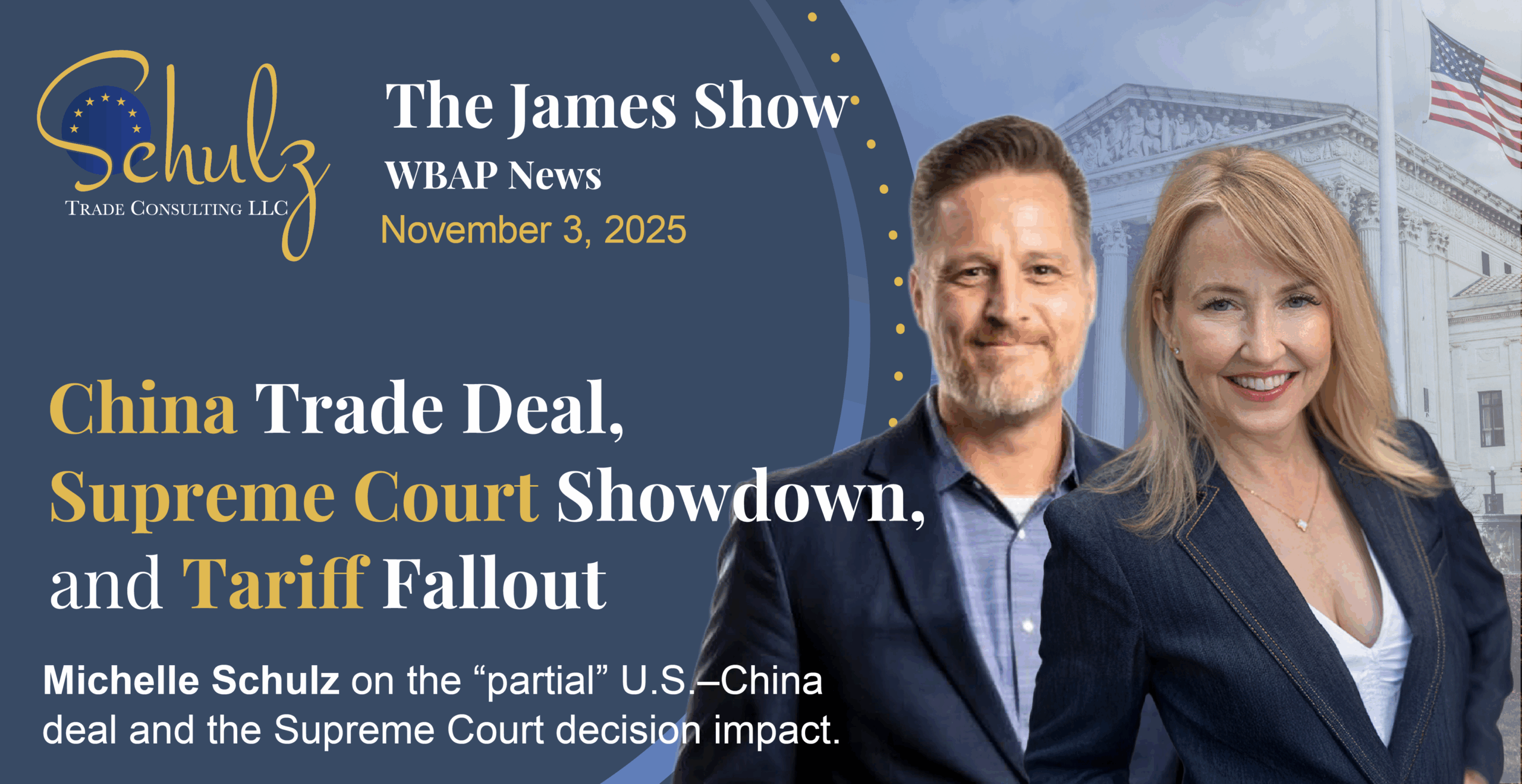
  • The China Trade Deal, Supreme Court Showdown, and Tariff Fallout

    The China Trade Deal, Supreme Court Showdown, and Tariff Fallout

    Michelle Schulz on WBAP Radio

    The China Trade Deal, Supreme Court Showdown, and Tariff Fallout

    Michelle Schulz Explains What’s Next on WBAP Radio

    Trade attorney Michelle Schulz breaks down the “partial” U.S.–China deal, who’s being hit hardest by tariffs, and what the upcoming Supreme Court decision could mean for importers and consumers alike.

    The James Show

    WBAP News

    Host: James Parker

    The Real-World Impact of Tariffs

    Discussing President Trump’s new “partial” China trade deal, Michelle Schulz, founder of Schulz Trade Law, explained that while the administration touts progress, the effects on American businesses remain severe.

    “I represent large companies, importers, and also small and medium-sized importers,” she said. “What I’m seeing is that companies of all sizes are impacted down to the individual. Business owners have contacted me saying, ‘My business is no longer sustainable because the tariffs on my goods are too high, and my customers won’t pay that.’”

    Schulz noted that some sectors—especially apparel, accessories, and small consumer goods—are struggling most.

    “We’ve got companies importing things like clothes and jewelry and shoes that just can’t make it under the current environment.” 

    The Supreme Court

    and the Limits of Presidential Power

    The interview also previewed the Supreme Court hearing scheduled for November 5, where justices will decide whether the President has legal authority to impose “reciprocal tariffs” under the International Emergency Economic Powers Act (IEEPA). Schulz explained:

    “The question is—Is this an emergency, or is this just for leverage? In my mind, the law is clear. An emergency would have to be more imminent harm rather than overall leverage in a multi-year trade war.”

    If the Court rules against the administration, Schulz said importers could be eligible for refunds on tariffs deemed unlawful.

    “Importers would have to go to customs and request refunds on anything that was ruled illegal,” she said. “It’s great for importers, but I wouldn’t expect it to happen quickly.”

    Even with a ruling against the President, Schulz noted that tariffs on steel, aluminum, and other materials would remain—since those were enacted under different laws tied to national security.

    The Long Game:

    China, the WTO, and the Future of Trade

    Looking beyond the immediate legal battles, Schulz explained that China’s long-term strategy remains focused and ambitious. “It’s only a partial deal,” she said.

    “Keep in mind, China’s looking long term—they’re hoping to integrate military and commercial products and have a world-class military by 2049.”

    Even if the Supreme Court strikes down some tariffs, Schulz expects the administration to continue pursuing alternative legal paths.

    “If it’s not an emergency, Trump has already initiated investigations for unfair trade practices and national security under Sections 301 and 232,” she explained. “They’re kind of a ‘Plan B.’”

    As for global recourse, Schulz noted that China could take the matter to the World Trade Organization, but is unlikely to prevail.

    “They could, but I don’t think they would fare well,” she said. “China has a reputation for not following WTO rules.”

    schulz trade consulting icon

    From shifting tariffs to court challenges, the trade landscape is changing daily.

    If your company imports goods from China or other affected countries, contact Schulz Trade Consulting today to assess your tariff exposure, explore refund opportunities, and develop compliance strategies for the next phase of global trade policy.

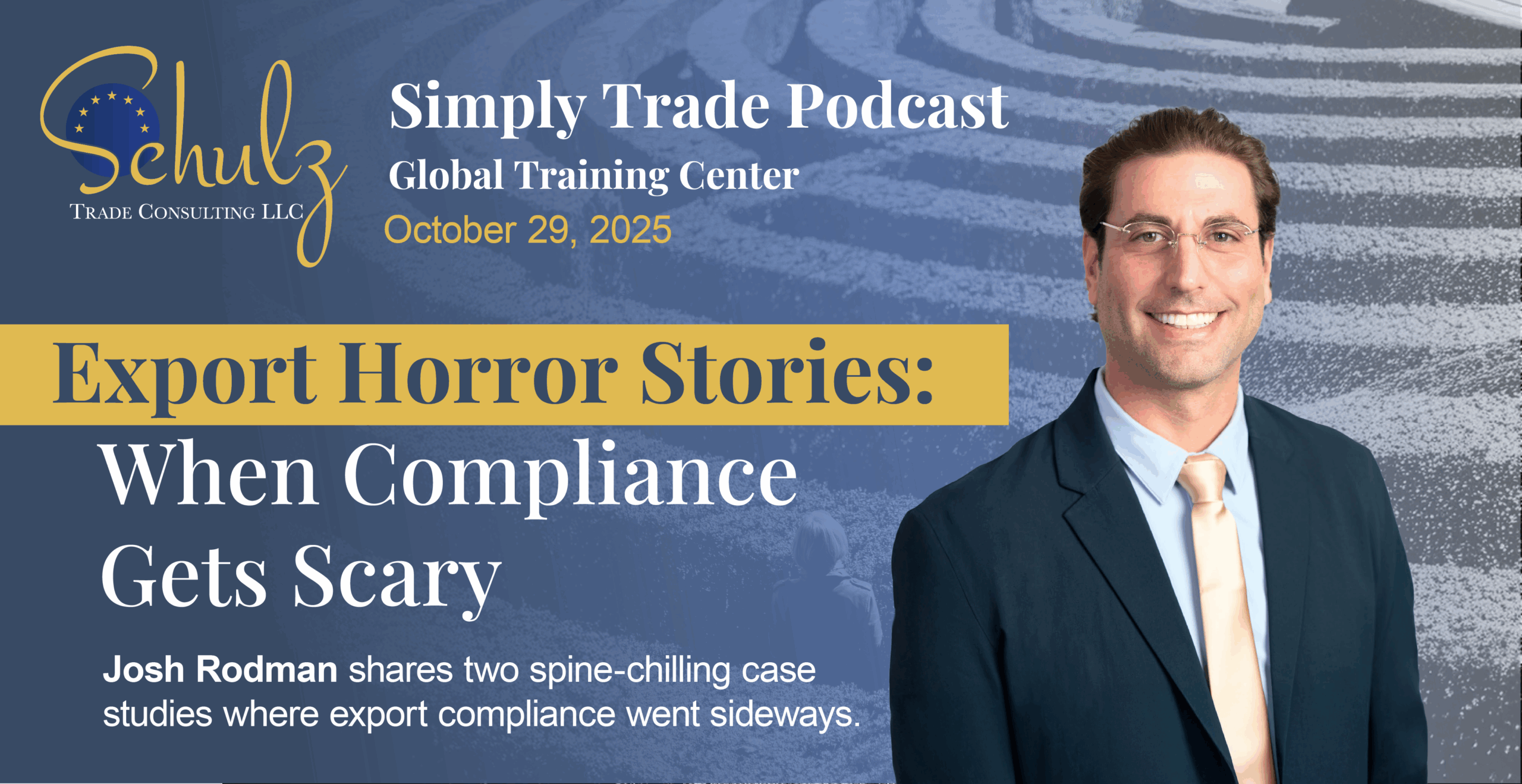
  • Export Horror Stories: When Compliance Gets Scary

    Export Horror Stories: When Compliance Gets Scary

    Josh Rodman on Simply Trade Podcast

    Export Horror Stories:

    When Compliance Gets Scary

    Attorney Josh Rodman from Schulz Trade Law joins Lalo and Andy to share two spine-chilling case studies where export compliance went sideways.

    In this Halloween Week special, the Simply Trade hosts dig into real-life trade horror stories that will make any exporter’s blood run cold.

    Simply Trade Podcast

    Global Training Center

    Hosts:  Lalo Solorzano & Andy Shales

    Export Horror Stories

    Attorney Josh Rodman from Schulz Trade Law joins Lalo and Andy to share two spine-chilling case studies where export compliance went sideways — despite good intentions. From ballistic helmets misclassified under the wrong ECCN to shipments to Russia caught in the tangled web of ever-changing export controls, this episode proves that in trade, even honest mistakes can summon costly consequences.

    Josh explains how voluntary self-disclosures (VSDs) can save a company from financial nightmares and why staying current with export regulations is critical to avoid getting haunted by unexpected investigations or penalties.

    This episode blends legal insight with cautionary tales — perfect for your Halloween listening lineup!

    Key Topics

    • Real-world export control “horror stories”
    • Misclassification of military equipment under ECCNs
    • Voluntary Self-Disclosures (VSDs) and how they mitigate penalties
    • OFAC subpoenas and overlapping U.S. government investigations
    • Russian sanctions, HTS code–based restrictions, and transshipment red flags
    • How exporters can protect themselves through due diligence and expert review

    schulz trade consulting icon

    If your company imports goods or relies on international materials, contact Schulz Trade Consulting today for guidance on tariff exposure, compliance, and global sourcing strategies in this shifting trade environment.

  • Tariffs, Inflation, and Rare Earth Leverage

    Tariffs, Inflation, and Rare Earth Leverage

    Tariffs, Inflation, and Rare Earth Leverage

    Michelle Schulz on What’s Next for Consumers and the Global Supply Chain

    Trade attorney Michelle Schulz joins WTMJ Radio to explain why furniture, construction materials, and electronics are about to get more expensive—and how China’s control of rare earth minerals gives it a powerful edge.

    Wisconsin’s Afternoon News

    WTMJ Radio

    Host: Julia Fello

    Tariffs Are Fueling Price Increases Across Everyday Goods

    In her WTMJ interview, international trade attorney Michelle Schulz confirmed that while consumers have already felt the effects of higher prices, the worst may still be ahead.

    “Building and construction will suffer a hit because steel, aluminum, and basic materials are going to be impacted,” she said. “Furniture and cabinetry have gone up—as high as 50%. Home buyers are going to be faced with a choice: source domestically or pay more for foreign furniture.”

    Schulz pointed to examples already visible in retail.

    “We’ve seen price increases at IKEA,” she noted, as the company’s popular Upland sofa rose from $850 to $900 and a three-piece oak bedroom set jumped from $960 to $1,050.

    Why Prices May Not Come Back Down

    Even if tariff pressures ease, Schulz warned that the price hikes are likely to stick.

    “It’s going to be difficult to undo the price increases once they really go into effect,” she said. “In the beginning, companies were more apt to absorb the cost, but they’re running out of that stocked-up inventory.”

    Economists call this “sticky pricing”—once companies reorganize their supply chains or reprice goods, those costs tend to remain. As Schulz emphasized, the early stages of the trade war allowed some flexibility, but rising costs across industries mean that cushion is now gone.

    China’s Leverage and the Global Supply Chain

    Looking ahead, Schulz warned that China’s response to U.S. tariffs could have even more far-reaching effects.

    China really controls the vast majority of the world’s rare earth minerals,” she said. “In retaliation to our tariffs, they’ve decided to place export controls on rare earth minerals going to foreign parties. We need those to make things like laptops, computers—virtually anything.”

    With the President preparing to attend the APEC summit and meet with Chinese officials, Schulz noted that this moment could be pivotal but not decisive:

    “Maybe the administration is starting to realize China’s leverage… but the trade war likely won’t end—it’s only the beginning of another phase.


    schulz trade consulting icon

    From furniture and construction to tech manufacturing, tariffs and supply disruptions are reshaping industries in real time.

    If your company imports goods or relies on international materials, contact Schulz Trade Consulting today for guidance on tariff exposure, compliance, and global sourcing strategies in this shifting trade environment.

  • Tariffs Tighten on Furniture and Wood: Michelle Schulz on WBAP Radio

    Tariffs Tighten on Furniture and Wood: Michelle Schulz on WBAP Radio

    Michelle Schulz on WBAP Radio

    Tariffs Tighten on Furniture and Wood

    Michelle Schulz Explains What’s Ahead for U.S. Buyers and Businesses

    International trade attorney Michelle Schulz outlines how new furniture and cabinetry tariffs—rising as high as 50%—are set to increase prices and pressure both importers and consumers.

    WBAP Morning News

    WBAP News

    Host: Ernie Brown and Carla Marion

    New Tariffs Take Effect

    During her interview with WBAP Radio in Dallas–Fort Worth, Michelle Schulz confirmed that the latest round of tariffs is already being felt across the furniture and cabinetry markets.

    “As of Tuesday, the new thing is furniture, wood cabinetry, kitchen cabinets that are imported are subject to a 25% tariff,” she said. “Vanities and associated products also 25%. Furniture and other cabinetry can go up to 50%, and we’re expecting this to increase to 50% for everything by January 1.”

    Schulz noted that the changes are happening fast and may continue to fluctuate:

    “I can’t predict if this will really happen or if this will change again, but this week, it’s happening.”

    Rising Costs and Consumer Confusion

    When asked whether consumers can see the tariff costs reflected in retail prices, Schulz explained that it’s not always transparent.

    “You might see a line that shows a tariff charge—or you might not,” she said. “There’s no requirement that a company show you which part is the tariff. But our clients are hiking up prices because they can’t keep up.”

    With supply chains still strained from earlier trade actions, the combination of new duties and high material costs could make furniture, cabinetry, and home goods even more expensive heading into 2026.

    How Tariffs Are Applied

    Schulz also broke down how tariffs are actually assessed—a common source of confusion among consumers.

    “The tariff is assessed at the time of customs entry,” she said. “Your tariff depends on what the tariff code was for the item at the time of entry. If you import a complete piece of furniture, you pay the tariff on the complete piece. If you’re importing components to assemble here, the tariff is on the components coming in.”

    She added that correct classification is critical: “

    It’s important to understand whether your tariff coding is correct. If it’s not, you could be overpaying—or facing compliance problems later.”


    schulz trade consulting icon

    Tariff classifications, rates, and enforcement are shifting rapidly—and they directly affect your bottom line.

    If your business imports furniture, wood products, or other home goods, contact Schulz Trade Consulting today to review your tariff codes, ensure compliance, and identify cost-saving opportunities before the next round of increases.

  • Tariff Turbulence: How Businesses are Coping with 100% Duties and Constant Change

    Tariff Turbulence: How Businesses are Coping with 100% Duties and Constant Change

    Tariff Turbulence

    Michelle Schulz on How Businesses Are Coping with 100% Duties and Constant Change

    International trade attorney Michelle Schulz explains how unpredictable tariff policies are straining U.S. importers, threatening livelihoods, and keeping compliance experts working around the clock.

    POTUS Politics

    SiriusXM Radio

    The Briefing with Steve Scully

    Host: Brian Ross

    Uncertainty as the New Normal

    As President Trump threatens to impose 100% tariffs on Chinese goods starting November 1, trade attorney Michelle Schulz says clients are scrambling to adapt.

    “None of our clients were prepared for this,” she explained. “They’re getting kind of used to being surprised… it’s a moving target.”

    Schulz described the constant shifts as a daily challenge for business owners. With policy reversals happening overnight, she tells clients to stay alert and verify the tariff rates in effect on any given day.

    “We sort of expected this could change—and it did. I expect it will change again.”

    Tariffs, Liability, and Survival Strategies

    For many companies, the unpredictability isn’t just inconvenient—it’s existential. “In some cases, it’s even threatening the livelihood of the business itself,” Schulz said. She emphasized that importers, not foreign exporters, pay the tariffs, meaning U.S. businesses shoulder the full cost.

    It’s not sustainable. It can shut down companies, and it will shut down some.”

    To survive, Schulz advises clients to focus on compliance and precision. That includes properly classifying goods, determining accurate country of origin, and ensuring correct valuation to avoid overpaying—or worse, being penalized for underreporting.

    “If you undervalue your goods and it’s fraudulent, you can end up with penalties two or three times the duties you owed,” she warned. “But if you correctly value your goods and the duties are lower based on customs guidance, you can get your duties down legally.”

    Tracking Chaos:
    Tariff Maps, Bond Hikes, and Lobbying Efforts

    As tariffs expand to nearly every major trade partner, Schulz’s firm is working nonstop to track changes in real time. “We use charts and spreadsheets,” she said.

    “Our firm has a tariff tracker on our website, and sometimes it needs to be updated daily or hourly.”

    One underreported consequence, she added, is how rising tariffs are forcing U.S. Customs to demand higher import bonds—the insurance importers must carry to guarantee duty payments.

    “Customs is actively telling importers, ‘Your bond is not enough,’” she explained. “You could get a penalty for that.”

    Meanwhile, some companies are fighting back.

    “Larger companies are lobbying directly,” Schulz said. “Smaller ones are going through trade organizations like the American Association of Exporters and Importers, which have more push.”

    Her final note:

    “It’s definitely exciting, and it’s never a dull moment. But no one can predict what’s next—except that it will change.”

    schulz trade consulting icon

    With tariff policies shifting by the hour, accurate information and strategy are everything.

    If your company imports goods or components, contact Schulz Trade Consulting today to stay compliant, minimize costs, and protect your business against sudden policy shifts.

    Trade on, but trade informed!