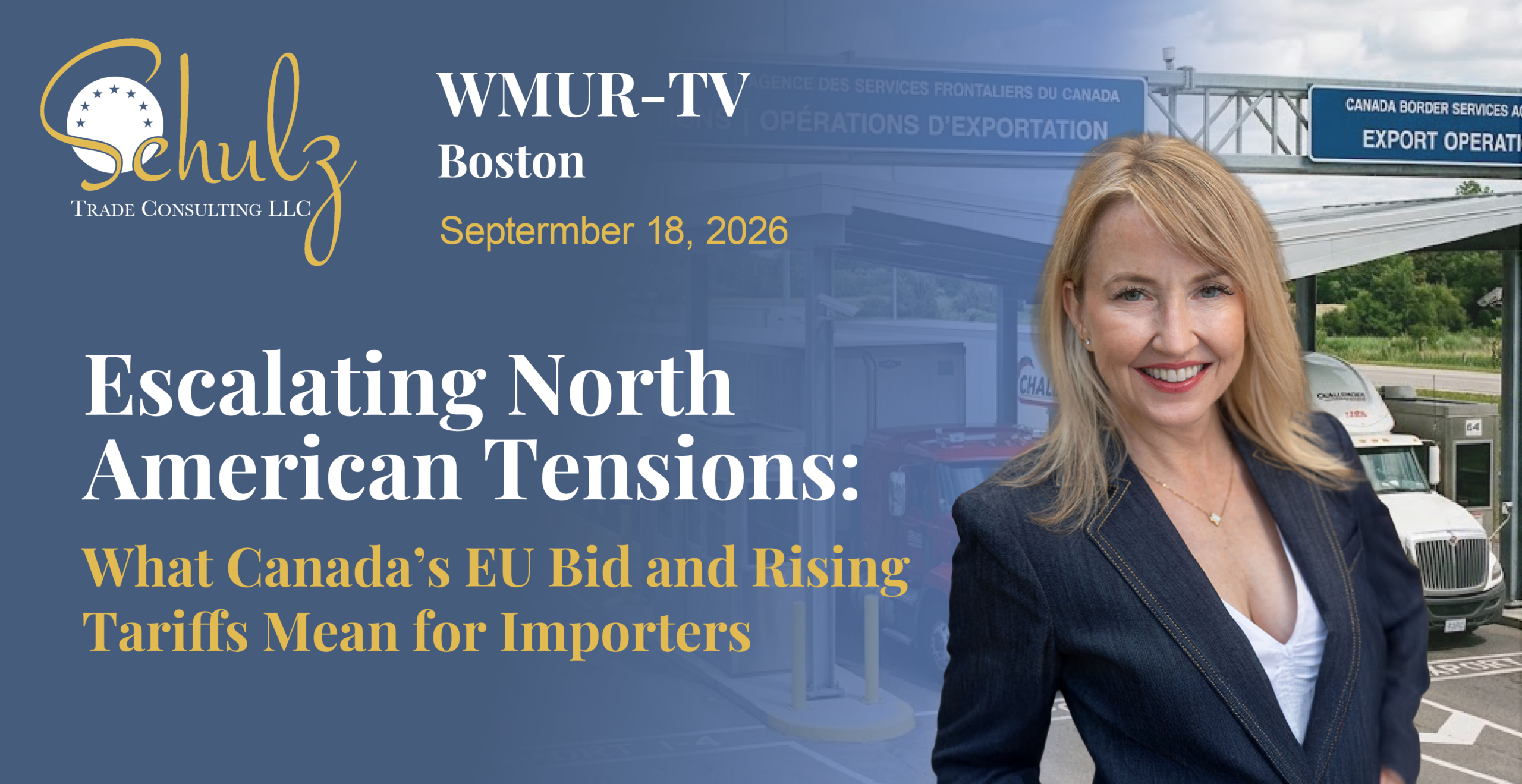
Escalating North American Tensions: What Canada’s EU Bid and Rising Tariffs Mean for Importers
As trade alliances shift and tariff pressures mount, U.S. importers face compounding supply chain costs and tough financial decisions.
Summary:
Recent proposals for Canada to join the European Union as an associate member have drawn sharp warnings from Washington, threatening severe escalation in an already volatile trade climate. With existing duties on European and Canadian goods heavily impacting the market, experts warn that businesses and consumers will bear the brunt of rising cross-border friction.
The intersection of shifting geopolitical alliances and aggressive tariff policies is creating unprecedented uncertainty for North American supply chains. With over $380 billion in Canadian goods imported into the U.S. annually, any structural break or alignment shift threatens to disrupt critical manufacturing inputs, force longer supply routes, and introduce heavy administrative hurdles. Importers are forced to re-evaluate traditional logistics networks while navigating steep existing penalties that squeeze profit margins across multiple industries.
Addressing the immediate financial fallout on domestic companies, Michelle Schulz, founder and managing partner of Schulz Trade Law, noted the difficult decisions facing businesses caught in the crossfire:
“US companies that are importing from Canada, they’re saying, you know, we may just have to pass on the costs. And that’s a little—a little scary for all of us.”
As regulatory pressures and potential retaliatory tariffs evolve, proactive compliance and supply chain strategy remain critical.
Navigating complex tariff updates and trade volatility requires expert guidance.
Contact Schulz Trade Consulting today to consult with our international trade attorneys and protect your supply chain operations.
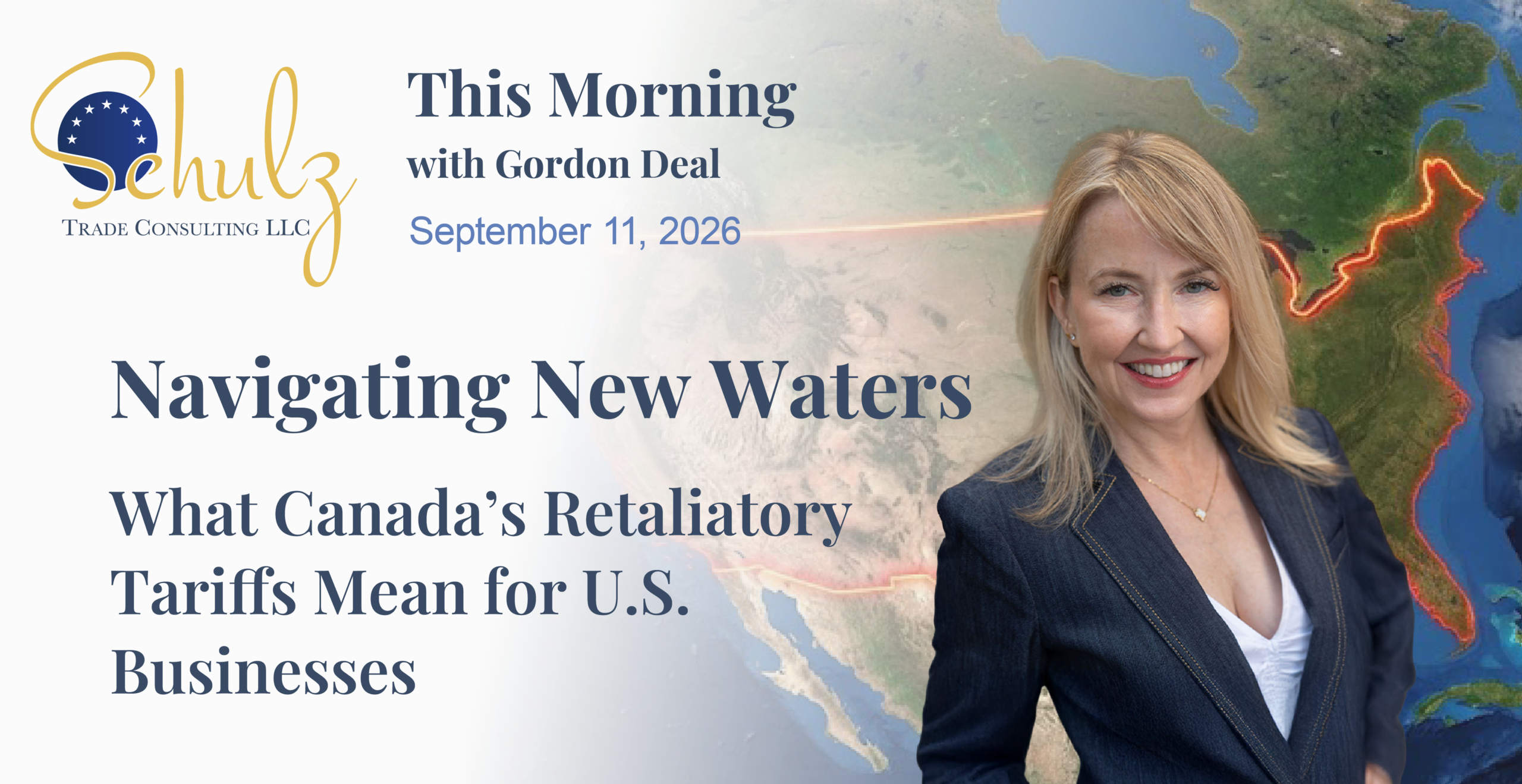
Navigating New Waters: What Canada’s Retaliatory Tariffs Mean for U.S. Businesses
International trade attorney Michelle Schulz breaks down the shifting U.S.-Canada trade landscape and how companies can adapt.
Summary
After Canada implemented dollar-for-dollar retaliatory tariffs on U.S. goods, businesses face higher costs, complex compliance demands, and unprecedented uncertainty. Michelle Schulz outlines the practical impacts on cross-border logistics and offers strategic guidance for navigating these changes.
The trade dynamics between the United States and Canada have taken a sharp turn as Canada officially enacts retaliatory tariffs against U.S. goods entering its borders.
Designed to match recent U.S. tariffs dollar-for-dollar, these new measures affect a broad spectrum of commercial exports and significantly alter the logistics of cross-border commerce. International trade attorney Michelle Schulz, founder and managing partner of Schulz Trade Law and Schulz Trade Consulting, emphasizes that companies must prepare for a far more complex environment.
“Canada has decided to retaliate against the many tariffs that we have imposed on Canadian products entering the United States,” Schulz explains. “Canada is going to, dollar for dollar, impose tariffs on US products entering Canada. So, that means it’s going to be much harder for US companies to do business with Canada, to export to Canada, and to make sales to Canadian customers.”
Beyond the broad policy shifts, the day-to-day operational reality for importers and exporters is undergoing a massive shift. Navigating custom entries now requires meticulous preparation to avoid financial pitfalls, as Canadian customs begins collecting duties of up to 50% on select items to mirror U.S. policies. Schulz points out that the administrative and financial weight falls heavily on the importing entities, slowing down established supply chains.
“When you import and export, there is a heavy paperwork burden… Canadian customs will collect higher duties up to 50% that mirror the duties we’re collecting,” Schulz notes. “The interesting thing here really is, it’s the importer who pays duties… And trade will slow. It will certainly slow and it will certainly become more expensive.”
In light of these rapidly shifting rules, proactive planning is essential to mitigate financial risk and preserve cross-border commercial relationships. While public debate includes extreme scenarios such as ending trade entirely, the practical imperative for businesses is to focus on immediate compliance and duty accuracy. Schulz advises companies to recalibrate their supply chain strategies without delay to avoid severe regulatory consequences.
“Pivot again… It’s not an easy situation, and you certainly need to know exactly what duties you’re going to be charged when you export from the US and import into Canada,” Schulz cautions. “Those calculations need to be sorted out now. I would prepare and plan ahead for this change… If you’re not prepared, then you open yourself up to penalties for duty underpayment.”
Ensure Your Business Remains Compliant and Competitive
Don’t let unexpected tariff shifts disrupt your supply chain or lead to costly penalties.Contact Schulz Trade Consulting today to review your cross-border compliance strategy and safeguard your international business operations.
Supreme Court Tariff Ruling: Navigating New Import Realities and Potential Refund Pathways
Following a landmark 6–3 Supreme Court decision striking down executive tariffs, Michelle Schulz provides strategic context on alternative tariff mechanisms and the path toward recovery for U.S. importers.
Summary
In a major legal shift, the U.S. Supreme Court ruled 6–3 that key executive-imposed tariffs were unconstitutional due to a lack of explicit congressional approval. Speaking on KXAN-TV, international trade attorney Michelle Schulz addressed the immediate operational implications for businesses facing a rapid pivot to alternative tariff structures and explored whether companies can expect refunds on duties previously paid.
The U.S. Supreme Court delivered a decisive 6–3 ruling holding that broad tariffs enacted without congressional authorization breached constitutional boundaries. While the decision invalidates significant duties previously imposed under executive order, the administration has signaled a swift pivot toward alternative statutory authorities—including a temporary 10% global tariff and other legal channels—to maintain revenue and trade pressures. For corporate leadership, this decision offers immediate legal relief on one front while introducing new compliance hurdles as the executive branch leverages alternative trade statutes to keep duty obligations in place.
Discussing the ruling’s real-world impact on KXAN Radio, Michelle Schulz highlighted the ongoing friction felt across the supply chain, noting,
“For the most part, importers are frustrated because they do have to pay those tariffs, and if they don’t pay them, they get penalized.”
U.S. importers have absorbed heavy financial strain under recent duty policies, facing severe administrative penalties or inventory holds for non-compliance. While the court’s ruling challenges the validity of certain tariff programs, importers cannot afford a lapse in compliance. Businesses must navigate shifting Customs enforcement, precise classification standards, and emerging regulatory frameworks as new trade measures take effect to avoid costly delays at ports of entry.
For businesses seeking financial recovery on duties paid under the invalidated authorities, the court’s decision opens a potential avenue for refunds, particularly regarding IEEPA-based tariffs. Addressing the outlook for duty recovery, Schulz observed,
“The refund process is—it gives me some hope. There may be refunds available on these IEEPA tariffs, but importers should keep in mind that that could take a very long time, and it could be a complex, nuanced…”
As noted during the broadcast, recovering paid duties will not happen overnight. The refund process is expected to be a multi-layered, highly technical legal procedure requiring meticulous documentation, strategic protest filings, and ongoing monitoring of Court of International Trade directives. Importers are encouraged to audit past entry summaries immediately to preserve their rights for monetary recovery.
Small Businesses Push Back as New Tariff Wave Hits Global Supply Chains
Trade attorney Michelle Schulz details how stacking tariffs are disproportionately impacting importers on This Morning with Gordon Deal.
Summary
International trade attorney Michelle Schulz joined This Morning with Gordon Deal to explain how small businesses are mounting legal challenges against broad, stacking tariffs that disproportionately impact their operations. To protect their bottom lines, Schulz recommends that importers proactively file administrative protests with Customs and Border Protection to preserve their legal rights and secure potential duty refunds before entries liquidate.
As small businesses navigate an increasingly complex international trade landscape, a growing coalition of importers is taking legal action to challenge the latest round of federal import taxes.
Appearing on This Morning with Gordon Deal, international trade attorney Michelle Schulz, founder and managing partner of Schulz Trade Law in Dallas, outlined how expanding tariff measures are straining commercial operations across the country. Importers are facing overlapping duty burdens, with rates rising anywhere from 10% to 12.5% across multiple categories. Schulz explained that administrative frameworks originally structured for targeted trade policy are now being applied broadly, creating widespread confusion and financial hardship.
As Schulz noted,
“Small businesses are really still reeling from Section 122, Section 232, Section 301, and they’re very confused overall about what tariffs they owe, how much they owe, and what they can still recoup and refund.”
A primary driver of recent legal challenges centers on the administration’s use of broad trade policy mechanisms under the banner of targeted remedies. For instance, recent Section 301 forced labor designations have applied sweeping 12% tariffs across approximately 60 countries, placing a blanket tax burden on all incoming shipments regardless of individual supply chain integrity. According to Schulz, small importers bear a disproportionate burden under these broad enforcement actions compared to larger corporations with deep compliance budgets.
“Small businesses are suing to block the latest import taxes because… they’re challenging Trump’s authority, but they’re saying that Trump is using mechanisms intended for targeted tariffs to impose broad tariffs,” Schulz stated. “Every importer is subjected to that tariff. So small businesses are saying, ‘Hey, wait, you’re just using that tariff to apply a broad tariff to everyone,’ and that impacts small businesses disproportionately.”
Despite these daunting market conditions, small businesses have secured significant financial victories through proactive legal and administrative remedies. Schulz reported that her firm alone has already recovered over $5 million in IEEPA tariff refunds for clients of all sizes since May, demonstrating that legal recourse remains viable. To safeguard bottom lines against the newest wave of tariffs, importers are encouraged to explore administrative options such as Customs and Border Protection protests, which offer a faster, lower-cost method to preserve refund rights before entry liquidations occur.
“In regard to the most recent tariffs, they can file a lawsuit, they can file a protest,” Schulz advised. “Protests are typically the way to go as far as administrative remedies. They’re less expensive than filing a lawsuit… simpler, faster, and they will preserve your right to contest the amount on your entry.”
Protect Your Import Operations & Recoup Excess Duties
Navigating 50% Canadian Tariffs and USMCA Instability: Insights from Michelle Schulz
International Trade Law Expert Michelle Schulz Weighs In on the 50% Canadian Tariff Proclamation and Growing Uncertainty in North American Trade
Summary
In a recent appearance on This Morning with Gordon Deal, Michelle Schulz, Founder and Managing Partner of Schulz Trade Law, analyzed the White House’s announcement of up to $50\%$ tariffs on Canadian imports and the ongoing disruption to the U.S.-Mexico-Canada Agreement (USMCA). Schulz provided critical guidance for U.S. importers and exporters facing unprecedented planning challenges amid shifting trade policies.
Recent Tariff Proclamations and the USMCA Framework
The federal government’s invocation of executive authority to impose $50\%$ duties on broad categories of Canadian goods—citing alleged trade discrimination in sectors such as dairy, alcohol, and automobiles—marks a significant shift in North American commerce. Addressing whether these measures are justified responses or escalations, trade attorney Michelle Schulz emphasized that the underlying friction points have long been part of standard USMCA negotiations. “We have been addressing these areas already under the U.S.-Mexico-Canada Agreement, and these had been the subject of much discussion over the past several years during negotiations anyway,” Schulz noted, pointing out that stepping away from established treaty frameworks is what ultimately triggered the current friction.
Strategic Planning Challenges for Importers and Exporters
For businesses that rely on supply chain predictability, the sudden potential suspension of duty-free treatment creates a severe planning deficit. After decades of relying on duty-free mechanisms under NAFTA and the USMCA, companies must now navigate shifting duty rates, potential Section 301 actions, and uncertain exclusion criteria. “It’s nearly impossible to plan,” Schulz explained during the interview. “We have so many clients who were using the advantages of the USMCA to import and export… and they could not plan ahead at this point because we didn’t even know if we were going to be able to use the USMCA.” She advised businesses to scrutinize product classifications, verify specific exemption status, and prepare for higher landed costs before finalizing cross-border transactions.
Looking Ahead: The Broader Trade Landscape and Isolation Risks
As trade officials signal that additional tariffs under various legal provisions may be on the horizon, U.S. businesses face a long-term shift toward trade isolationism. While other global economies continue forging bilateral and multilateral trade pacts, U.S. importers must prepare for continued volatility. Until broader diplomatic negotiations resume or policy priorities shift, proactive duty management and rigorous compliance audits remain the primary tools for companies seeking to mitigate exposure. Schulz advised companies to continuously monitor tariff schedules, evaluate product-level impact, and explore strategic supply chain adjustments.
Protect Your Supply Chain from Tariff Volatility
Navigating rapid changes in tariff schedules, USMCA compliance, and cross-border regulatory exposure requires proactive legal strategy.
Contact Schulz Trade Consulting today to conduct a comprehensive tariff risk assessment and safeguard your international business operations.
Why the Global Supply Chain Won’t Recover Overnight
The agreement to reopen the critical waterway is a major step forward, but a massive backlog of vessels and ongoing safety concerns mean supply chain relief will take weeks—if not months—to materialize.
Summary
While news of an agreement to reopen the Strait of Hormuz offers a glimmer of hope for global commerce, international trade experts warn that a return to normal operations is still far off. With over 500 ships stranded for months and critical safety measures like mine-sweeping still required, businesses must brace for continued shipping delays, inventory adjustments, and elevated freight costs in the near term.
The physical reopening of the Strait of Hormuz is only the first step in a long, complex recovery process. Over the course of the months-long shutdown, a massive backlog of roughly 500 cargo vessels has accumulated, leaving trillions of gallons of oil and critical commercial goods stranded at sea. Clearing this bottleneck will require unprecedented coordination, and operations cannot resume overnight.
Furthermore, the maritime environment remains hazardous. Before cargo ships can safely navigate the waterway, authorities must ensure that mines laid earlier this year are fully cleared. As Michelle Schulz noted during a recent interview on WBAP Radio, Dallas-Fort Worth:
“It’s going to take some time… Keep in mind that ships have been stuck for over 100 days, so beginning operations again is not going to be a quick fix. Assuming that an agreement is reached and that the Strait does open, there are many things that still need to be done. For example, clearing mines that were laid earlier on this year.”
Because of these safety imperatives, maritime tracking data suggests that it will take weeks, if not months, for the backlog to entirely dissipate and for standard shipping schedules to normalize.
Shifting Strategies: How Importers and Exporters are Adapting
The prolonged instability in the region has forced global businesses to fundamentally re-evaluate their supply chain resilience. Relying on a single, vulnerable transit route is no longer a viable strategy, leading many companies to explore alternative—and often much costlier—routes, such as circumnavigating the African continent.
To mitigate ongoing delays and safeguard their operations, proactive importers and exporters are utilizing specialized customs and trade mechanisms to manage their cash flow and inventory. Michelle Schulz explained how companies are currently navigating these choppy waters:
“Our clients are navigating how they’re going to ship and the shipping routes. They’ve been exploring alternate routes and, in addition to that, experiencing delays… Some are looking at mechanisms like bonded warehouses, foreign trade zones, and there’s actually no great solution, to be honest. There’s no perfect solution. But companies are trying to do their best to strategize to minimize the damages on delays and extra expenses.”
Ultimately, these extended routes and strategic pivot points come with a price tag. Higher operational expenses and freight fees will continue to trickle down the supply chain, impacting both corporate bottom lines and retail consumers alike.
Mitigate Your Trade Risks
Navigating global supply chain disruptions requires proactive legal and logistical strategy. Whether you need to review your current shipping contracts, evaluate force majeure clauses, or leverage trade programs like Foreign Trade Zones (FTZs) and bonded warehouses to protect your inventory, Schulz Trade Law is here to help.
Navigating the Perfect Storm: How Tariffs and Supply Chain Crises Are Compounding for U.S. Importers
The dual pressures of escalating trade barriers and the closure of the Strait of Hormuz are forcing businesses to rethink their global logistics strategies.
Overview
The international trade landscape has rarely been more volatile. Today, U.S. importers are facing a devastating “one-two punch”: the sudden, indefinite disruptions in the Strait of Hormuz alongside rapidly shifting global tariffs.
For small and mid-sized businesses, the financial strain of navigating these simultaneous crises is reaching a breaking point, making strategic legal guidance and supply chain adaptation more critical than ever.
The current maritime crisis in the Middle East has left hundreds of commercial vessels in limbo. With standard shipping lanes effectively blocked or deemed unsafe, companies are facing unprecedented logistical gridlock. The source of the delay isn’t just the initial disruption, but the highly technical and slow-moving safety operations required to clear the waters.
As Michelle Schulz noted in a recent interview, the timeline for recovery remains incredibly uncertain:
“Supposedly there were mines laid earlier on this year, and those mines have to be swept by underwater drones. So, ships and containers are somewhat at risk if if that hasn’t been fully cleared. And shipping companies are cautious… they really haven’t been many changes to their operations in the region because they don’t know yet if it’s safe, and they haven’t seen a lot of improvement.”
With shipping companies hesitant to alter their operations without guaranteed safety, importers must prepare for extended inventory delays that could last for months.
A Compounding Crisis: The One-Two Punch of Tariffs
Logistical delays are only half of the battle. Businesses trying to reroute their goods or manage delayed arrivals are simultaneously being hit by volatile tariff policies. This creates an environment where long-term financial planning becomes nearly impossible, as costs rise on a daily basis.
Schulz highlights how these overlapping issues are uniquely overwhelming for businesses right now:
“And they’re dealing with this and at the same time with tariffs that are escalating and changing every day. It’s nearly unmanageable… Many of these clients did not see this coming, and so they’re just dealing with multiple issues at the same time. They may have already relocated because of other trade issues, and now we have this issue in this part of the world. So, there’s really no place that’s safe. We have tariffs in virtually every country, and U.S. importers are paying those. So, it’s kind of compounding. That’s what I’m seeing is that it’s compounding all of these issues.”
When geopolitical friction and fiscal policy collide, the traditional “safe harbors” for manufacturing and sourcing quickly vanish.
The Small Business Breaking Point
While multinational corporations often possess the capital reserves and extensive legal departments necessary to weather these systemic shocks, smaller enterprises are facing an existential threat. The margins required to absorb massive, unexpected operational overhead simply do not exist for many manufacturers and importers.
The divide between corporate resilience and small business vulnerability is widening rapidly, as Schulz observed:
“The clients that I’ve been working with are struggling. They can’t absorb the costs, and especially the smaller businesses can’t absorb the additional overhead, the additional tariffs that they’re paying. In some cases, you know, 25%, 50%, they simply are struggling and may not make it.”
For these smaller entities, surviving the current trade climate requires aggressive cost-mitigation strategies, tariff classification reviews, and immediate compliance adjustments.
Are Compounding Trade Issues Threatening Your Bottom Line?
Navigating shifting tariffs and maritime disruptions requires more than just patience—it demands a proactive legal strategy. Whether you need to audit your tariff classifications, explore alternative sourcing destinations, or review force majeure clauses, Schulz Trade Consulting is here to help you protect your business.
Scrapping the USMCA? Navigating the High Stakes of North American Trade Uncertainty
Insights from Trade Attorney Michelle Schulz on the potential end of the landmark agreement and what it means for businesses.
Overview
Recent statements indicating a potential decision not to renew the United States-Mexico-Canada Agreement (USMCA) have sent shockwaves through the corporate landscape. In this post, international trade attorney Michelle Schulz breaks down the sudden shift in rhetoric, the severe logistical and financial threats facing U.S. importers, and the strategic pivots companies must prepare for as regional trade stability hangs in the balance.
“Trump threatens to kill trade deal with Mexico, Canada”
Host: Gordon Deal
Listen
A Surprising Shift in Continental Trade Policy
For over three decades, North American supply chains have relied on a predictable framework of regional cooperation. Beginning with the implementation of the North American Free Trade Agreement (NAFTA) in 1993, and later modernized through the USMCA in 2018, cross-border commerce has long been viewed as relatively stable. However, recent developments have suddenly disrupted that assumption, indicating that the entire agreement could be scrapped rather than renewed at its upcoming six-year milestone.
While past negotiations pointed toward potential revisions or a shift toward individual bilateral agreements with Canada and Mexico, the prospect of dismantling the trade framework entirely comes as a stark surprise to the business community. As Michelle Schulz notes,
“We’re learning that the deal is not quite as set in stone as we may have thought… now he’s saying, maybe we scrap the whole thing”.
Cited concerns over structural issues and drafting errors within the text have cast doubt on an agreement previously championed as a major legislative achievement, reminding businesses that continental trade status is never permanently set in stone.
The Importers Facing the Hardest Hit
If the USMCA is permitted to expire, the consequences will ripple across multiple industries, but U.S. importers will undoubtedly bear the heaviest burden. Countless domestic enterprises utilize the agreement on a daily basis to secure duty-free treatment on critical inputs, components, and finished goods flowing from Canada and Mexico. Without this legal framework, a massive volume of cross-border commerce would immediately become subject to standard tariffs, instantly spiking procurement costs.
Schulz emphasizes the gravity of the situation for domestic businesses:
“In my view, US importers… use the USMCA daily. We have routine importers that use USMCA to claim duty-free treatment on imports from Canada and Mexico… If this agreement didn’t exist, it would be a huge logistical nightmare for companies in the United States”.
Forcing these deeply integrated, multi-step operations to navigate standard customs barriers without preferential trade status would bottleneck border logistics and disrupt just-in-time production schedules across the continent.
From Automotive Parts to Agricultural Essentials
The reliance on zero-tariff North American trade spans nearly every sector of the physical economy. The automotive and industrial machinery fields are particularly vulnerable, as they depend entirely on the steady flow of specialized components and car parts moving seamlessly between manufacturing hubs. Similarly, deep ties exist within agriculture and raw materials; the U.S. relies heavily on Canadian lumber, minerals, natural resources, and dairy, while closely co-developing textiles and consumer goods with Mexican partners.
A prime example of this integrated ecosystem is the maquiladora business model in Mexico, which allows companies to utilize highly affordable manufacturing and assembly labor before returning the goods to domestic markets. Schulz warns that ending the agreement would completely disrupt these operations:
“This would eliminate that entire business model. We would not be able to take advantage of the labor in Mexico. We would have to manufacture everything here, and it would become much more expensive”.
Prepare Your Supply Chain for Volatility
In an environment where trade policy changes from day to day, standing still is a risk your business cannot afford. At Schulz Consulting, we assist companies in auditing their current USMCA dependencies, modeling alternative tariff scenarios, and building agile logistics strategies to pivot on a dime.
Contact our Dallas office today to review your cross-border operations and secure your supply chain against sudden regulatory shifts.
“Earnestly and in good faith.” That is the DOJ’s standard for a functioning compliance program. The DOJ requires your compliance program to be implemented earnestly. Unfortunately, no one thought to tell the chatbot.
A language model that has never had a conviction, a belief, or a stake in anything cannot be earnest in either sense of the word. AI has no faith. It has no convictions, no institutional memory, no stake in whether your program holds up under scrutiny. It will draft your anti-corruption policy with the same indifference it uses to write a grocery list.
The Investigator Reads Differently Than the Model Does
Picture a seasoned DOJ attorney reviewing your third-party due diligence file. She is not checking whether the right words appear in the right fields. She is reading for judgment — did someone in your organization actually think about this? Did they push back, ask hard questions, flag the thing that looked wrong even when the numbers were fine?
Scenario 1
Mexico Trucking
A freight supervisor flags anomalous route deviations and off-book subcontractor payments to local haulers near a contested corridor. He files a report. It goes nowhere. An AI-generated risk summary rates the third party “medium” because the financial controls passed a checklist. The investigator reading that file in 2026 recognizes the pattern immediately: undocumented routes, local subcontractor pressure, a supervisor too cautious to say what he sees in writing. That is exactly the fact pattern DOJ is pursuing under its current cartel and TCO enforcement priorities. Material support exposure to a designated Foreign Terrorist Organization does not resolve with a fine. It resolves with an indictment. The model flagged nothing because it had no stake in what the facts meant.
The Quiet Scenario Is the More Dangerous One
Scenario 2
Latin America Government-Linked Vendor
A Latin America regional manager approves a series of payments to a government-linked event vendor across three markets. The amounts are individually defensible. The pattern is not. An experienced compliance officer in this environment knows that government-linked vendors in the region now carry a heightened scrutiny burden precisely because DOJ has made TCO nexus a primary FCPA enforcement consideration. What presents as a gift and entertainment issue may be the thread that unravels something far more serious. The investigator sees it. The model sees average transaction size and a completed approval form.
The Program That Survives Looks Different
It is built on what your last investigation actually taught you — the specific pressure points in West Africa construction, the margin dynamics in Southeast Asia logistics, the way pharma HCP speaker fees get approved in markets where your legal team is one time zone away. That institutional knowledge does not live in a model. It lives in people who understand what they are protecting and why.
“The challenge is not whether AI belongs in your compliance program. It does. The challenge is whether the judgment layer is real.”
Whether there is someone who reads a file the way a DOJ attorney would — before the DOJ attorney does.
For Your Team
What is the hardest call your compliance team made in the last 12 months that no AI tool would have caught?
Work with Us
Your Program Needs a Judgment Layer
Schulz Trade Consulting helps organizations build compliance programs that hold up under DOJ scrutiny — not just on paper, but in practice.
The $165 Billion Question: Navigating the New Tariff Refund Landscape
Michelle Schulz Discusses the Biden Administration’s Recent Stance on U.S. Importer Refunds
Overview
Following the implementation of an automated refund system for U.S. importers, a complex political dynamic has emerged. While $165 billion in tariff refunds is legally owed to businesses, reports suggest the administration is pressuring firms to forgo these claims. Michelle Schulz, founder of Schulz Trade Law, joined WTMJ Radio to break down what this means for the trade community.
The U.S. Bureau of Customs and Border Protection has recently streamlined its processes to handle an unprecedented volume of tariff repayments. Through the Automated Commercial Environment (ACE), a new sub-system known as CAPE (Consolidated Administration and Processing of Entry) was designed to return funds to importers of record within a 60-to-90-day window.
“It’s been interesting that the U.S. Bureau of Customs and Border Protection has actually built a system to repay businesses so quickly… they’ve developed an automatic system for refunds that is supposed to return the money to the importer of record within 60 to 90 days.”
— MICHELLE SCHULZ
Political Pressure vs. Legal Entitlement
Despite the legal framework entitling companies to these refunds, a new narrative is forming from Washington. Major news outlets report that the administration is discouraging firms from claiming their money, citing various political and economic justifications.
“It sounds like now the President has responded by saying, ‘You’re entitled to those refunds, but if you don’t take them, I will remember you.’ And so, you get brownie points if you just don’t take your money back.”
— MICHELLE SCHULZ
The Economic Reality for Importers
For many businesses, these refunds are not just bonuses but significant capital owed for overpaid duties. Choosing to forgo these funds to remain in the administration’s “good graces” presents a difficult dilemma for corporate leadership.
“To ask companies to just go ahead and not claim the money that they’re duly owed—it’s kind of like asking people not to claim their tax refund.”
— MICHELLE SCHULZ
Is Your Business Owed Tariff Refunds?
Navigating the intersection of trade law and federal policy requires expert
guidance. Don’t leave your capital on the table without understanding the full legal landscape.