Tag: ImportCompliance

  • Why Prices Keep Rising: Tariffs, Stacked Costs, and the New Reality for Consumers

    Why Prices Keep Rising: Tariffs, Stacked Costs, and the New Reality for Consumers

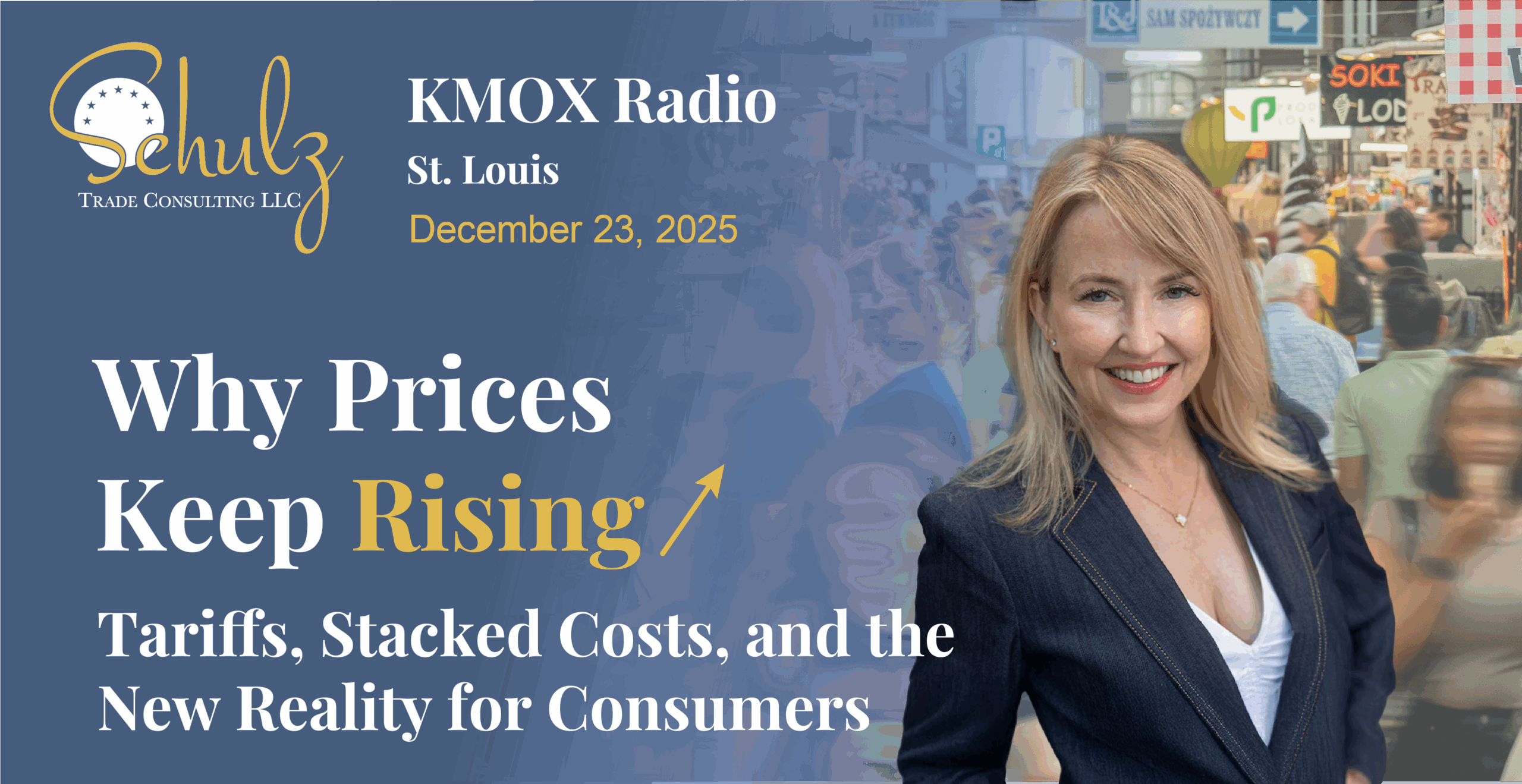
    Michelle Schulz on KMOX Radio

    Why Prices Keep Rising:

    Michelle Schulz explains how baseline tariffs and stacked duties are driving higher prices—from holiday gifts to cars.

    In a recent interview on KMOX Radio in St. Louis, Michelle Schulz, founder and managing partner of Schulz Trade Law, joined hosts to explain why consumers are paying more across nearly every product category.

    From holiday shopping to electronics and automobiles, Michelle outlined how broad-based tariffs—many of which apply regardless of country of origin—are quietly reshaping prices and leaving consumers with fewer goods for more money.

    knx los angeles logo

    KMOX Radio

    St. Louis

    Hosts: The Chris and Amy Show

    Baseline Tariffs and Why Everything Costs More

    Michelle explained that today’s price increases aren’t limited to a handful of imports or countries. Instead, nearly all imported goods are now subject to a baseline tariff—often starting at 10%—with no minimum value threshold.

    “Imported items have really resulted in hyped-up prices… there’s no minimum, so it doesn’t matter what you’re buying—it might be subject to a tariff.” 

    Even when individual tariffs are paused or adjusted, importers must price goods based on risk and uncertainty. As a result, consumers see higher prices regardless of whether a specific tariff is currently active.

    Modern kitchen with red pots on stove, white cabinets, and bright windows. Shelves with dishes. Neutral tones create a calm atmosphere.

    Which Products Are Being Hit the Hardest

    Certain categories have seen especially sharp increases. Kitchen goods, electronics, clothing, and shoes are among the most affected, with tariffs stacking on top of one another depending on product components and materials.

    “Kitchen goods are up about 38%, electronics about 34%, and clothes and shoes are going up at least 20%.” 

    Michelle noted that electronics often face multiple layers of duties—base tariffs plus additional tariffs on metals like aluminum, steel, and copper—compounding costs long before products reach store shelves. These increases are already showing up in major consumer purchases such as gaming consoles, appliances, and household electronics.

    Confusion, Classification, and Why Prices Rarely Come Back Down

    One challenge for both businesses and consumers is that tariffs are rarely itemized at checkout. Many companies fold tariff costs into pricing without disclosing them, making it difficult to track what’s driving increases.

    “There are different tariffs by product… every product is categorized by a Harmonized Tariff code, and tariffs can stack upon each other.” 

    Michelle also addressed whether prices are likely to fall. While some consumers hope reduced demand will force price corrections, she sees a different pattern emerging.

    “People are spending more, but they’re just coming away with less.” 

    Meaningful relief, she noted, would likely require court intervention—specifically a ruling by the Supreme Court of the United States on the legality of the broad emergency-based tariffs currently in place.

    Aerial view of a parking lot with rows of tightly packed cars. Lines and numbers mark spaces. Cars are mostly black and white.

    Beyond Retail: Cars, Equipment, and Long-Term Impact

    Tariffs aren’t just affecting consumer goods. Michelle highlighted rising vehicle prices, increased scrutiny at customs, and reduced demand for new agricultural and industrial equipment.

    “Tariffs are directly impacting the price of cars… people don’t want the new ones—they want the old, cheaper ones.” 

    As costs rise, businesses and consumers alike are delaying purchases, repairing older equipment, and adjusting expectations—signals of longer-term economic distortion rather than short-term price spikes.


    schulz trade consulting icon

    Tariffs are no longer an abstract trade issue—they affect pricing, purchasing power, and business planning across the economy.

    If your company imports goods and needs clarity on tariff exposure, classification, or cost-reduction strategies, Schulz Trade Consulting can help you navigate today’s trade landscape with precision and foresight.

  • Tariffs, Refund Races, and the Growing Cost of Trade Uncertainty

    Tariffs, Refund Races, and the Growing Cost of Trade Uncertainty

    Michelle Schulz on KCBS Radio

    Tariffs, Refund Races, and the Growing Cost of Trade Uncertainty

    Michelle Schulz breaks down refund lawsuits, Supreme Court risk, and why tariffs aren’t delivering their promised results.

    In a wide-ranging interview on WLW Radio’s Scott Sloan Show, Michelle Schulz, founder and managing partner of Schulz Trade Law, discussed the growing legal and economic fallout from U.S. tariff policy.

    With billions of dollars already collected, major companies racing to secure refund rights, and farmers and importers absorbing long-term damage, Michelle explained why the current tariff regime is creating uncertainty rather than leverage—and what businesses should be doing now.

    WLW Radio

    Cincinnati

    Host: Scott Sloan

    The Race for Refunds and a Legal Bottleneck

    As tariffs continue to generate massive revenue, large companies such as Costco, Revlon, and Ray-Ban have moved quickly to preserve their ability to receive refunds if the tariffs are ultimately struck down. These companies sought to block U.S. Customs from finalizing duty calculations—known as liquidation—to speed up repayment.

    That effort failed. The U.S. Court of International Trade denied a consolidated motion to delay liquidation, setting the stage for a much longer refund process if the tariffs are overturned.

    “If all that has to be refunded, then it does have to be refunded—but we’re going to have to go through a long process to get that money back.”

    Michelle warned that even if refunds are legally required, administrative reality means companies could wait months or years to recover billions already paid.

    Supreme Court Uncertainty and a $130 Billion Problem

    The potential scale of refunds is unprecedented. According to filings referenced in the interview, roughly $130 billion in tariffs has already been collected—and that number continues to grow.

    Michelle noted that while the Supreme Court of the United States initially expressed skepticism about the legality of these tariffs, the outcome is no longer predictable.

    “In the beginning, I thought it was pretty likely the Supreme Court would strike them down… but the more I read and follow the government’s reactions, I think it could go either way.” 

    If the Court invalidates the tariffs after liquidation occurs, importers will still be entitled to refunds—but only through a formal protest process that Customs is historically slow to administer.

    Why Tariffs Aren’t Working—and Who’s Paying the Price

    Michelle also addressed whether tariffs are achieving their stated goals, particularly with respect to China. The data suggests otherwise: China’s trade surplus continues to grow as it expands exports to other regions, while U.S. importers and farmers absorb higher costs and retaliatory losses.

    “Relative to China, we can see that the tariffs really aren’t having the intended effect… China seems to be fine.” 

    Farmers face a double burden: higher import costs for equipment and lost export markets due to retaliation. Subsidy checks, Michelle noted, do little to offset structural damage or restore lost demand.

    At the same time, U.S. companies are increasingly viewed as unreliable trading partners, as sudden tariffs, price renegotiations, and policy reversals undermine long-term relationships abroad.

    What Importers Can Do Now

    Despite the uncertainty, Michelle emphasized that businesses still have meaningful opportunities to reduce exposure. Reviewing tariff classifications, country-of-origin determinations, and—especially—customs valuation can uncover significant overpayments.

    “We’ve had importers overpaying because they were overvaluing their goods… sometimes it’s a technicality, but that technicality matters.”


    schulz trade consulting icon

    Tariff uncertainty isn’t going away—but overpayment doesn’t have to be inevitable.

    If your company imports goods and is concerned about duties, refunds, or compliance risk, Schulz Trade Consulting can help you identify savings, prepare for potential refunds, and navigate trade complexity with confidence.