Tag: CustomsCompliance

  • Escalating North American Tensions: What Canada’s EU Bid and Rising Tariffs Mean for Importers

    Escalating North American Tensions: What Canada’s EU Bid and Rising Tariffs Mean for Importers

    Escalating North American Tensions: What Canada’s EU Bid and Rising Tariffs Mean for Importers

    As trade alliances shift and tariff pressures mount, U.S. importers face compounding supply chain costs and tough financial decisions.

    Recent proposals for Canada to join the European Union as an associate member have drawn sharp warnings from Washington, threatening severe escalation in an already volatile trade climate. With existing duties on European and Canadian goods heavily impacting the market, experts warn that businesses and consumers will bear the brunt of rising cross-border friction.

    WMUR-TV

    Reporter: Amy Lu

    Hearst TV’s Washington, D.C. correspondent

    The intersection of shifting geopolitical alliances and aggressive tariff policies is creating unprecedented uncertainty for North American supply chains. With over $380 billion in Canadian goods imported into the U.S. annually, any structural break or alignment shift threatens to disrupt critical manufacturing inputs, force longer supply routes, and introduce heavy administrative hurdles. Importers are forced to re-evaluate traditional logistics networks while navigating steep existing penalties that squeeze profit margins across multiple industries.

    Addressing the immediate financial fallout on domestic companies, Michelle Schulz, founder and managing partner of Schulz Trade Law, noted the difficult decisions facing businesses caught in the crossfire:

    “US companies that are importing from Canada, they’re saying, you know, we may just have to pass on the costs. And that’s a little—a little scary for all of us.”

    As regulatory pressures and potential retaliatory tariffs evolve, proactive compliance and supply chain strategy remain critical.

    schulz trade consulting icon

    Navigating complex tariff updates and trade volatility requires expert guidance.

    Contact Schulz Trade Consulting today to consult with our international trade attorneys and protect your supply chain operations.
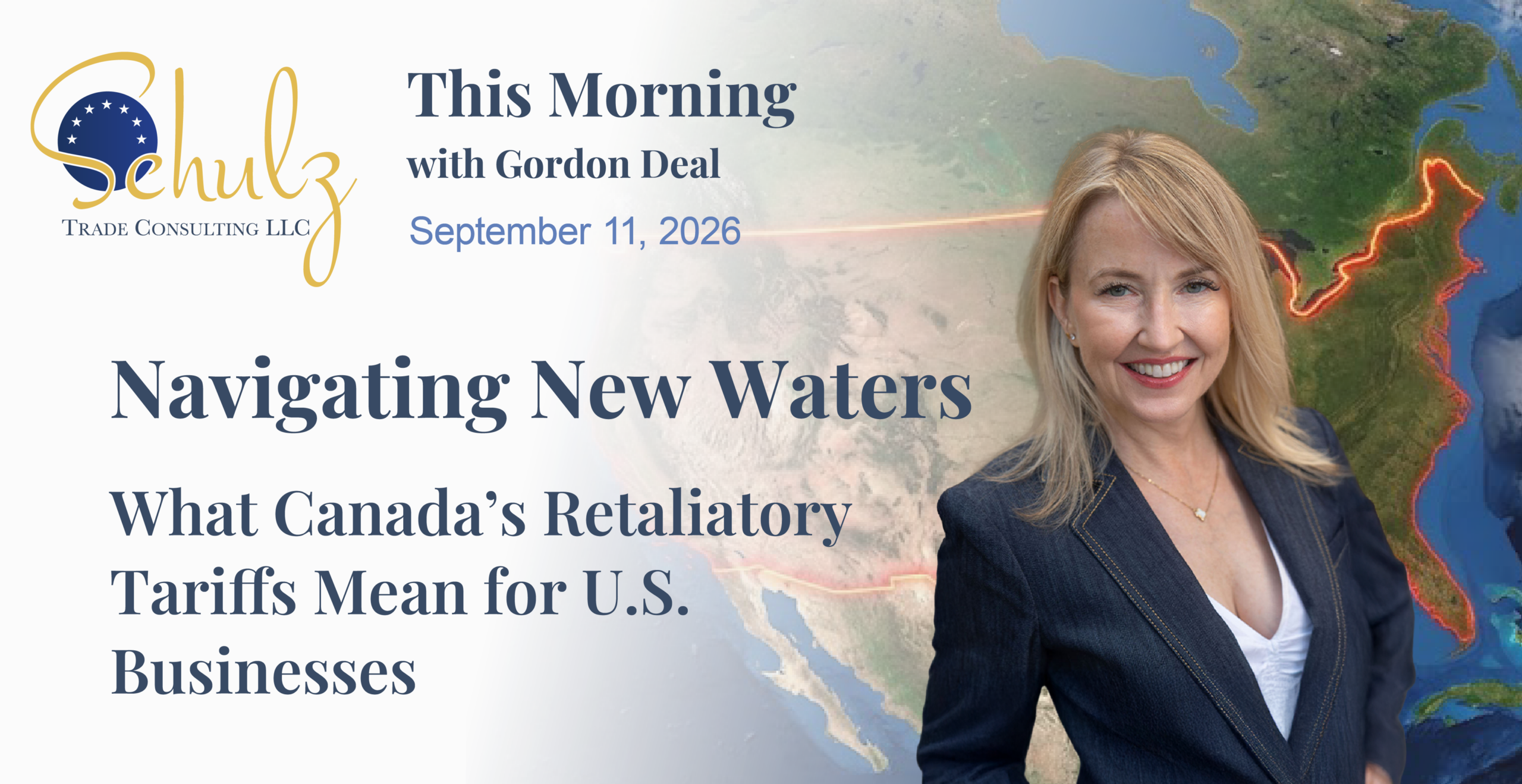
  • Navigating New Waters: What Canada’s Retaliatory Tariffs Mean for U.S. Businesses

    Navigating New Waters: What Canada’s Retaliatory Tariffs Mean for U.S. Businesses

    Navigating New Waters: What Canada’s Retaliatory Tariffs Mean for U.S. Businesses

    International trade attorney Michelle Schulz breaks down the shifting U.S.-Canada trade landscape and how companies can adapt.

    After Canada implemented dollar-for-dollar retaliatory tariffs on U.S. goods, businesses face higher costs, complex compliance demands, and unprecedented uncertainty. Michelle Schulz outlines the practical impacts on cross-border logistics and offers strategic guidance for navigating these changes.

    This Morning with Gordon Deal

    Host: Gordon Deal

    The trade dynamics between the United States and Canada have taken a sharp turn as Canada officially enacts retaliatory tariffs against U.S. goods entering its borders.

    Designed to match recent U.S. tariffs dollar-for-dollar, these new measures affect a broad spectrum of commercial exports and significantly alter the logistics of cross-border commerce. International trade attorney Michelle Schulz, founder and managing partner of Schulz Trade Law and Schulz Trade Consulting, emphasizes that companies must prepare for a far more complex environment.

    “Canada has decided to retaliate against the many tariffs that we have imposed on Canadian products entering the United States,” Schulz explains. “Canada is going to, dollar for dollar, impose tariffs on US products entering Canada. So, that means it’s going to be much harder for US companies to do business with Canada, to export to Canada, and to make sales to Canadian customers.”


    Beyond the broad policy shifts, the day-to-day operational reality for importers and exporters is undergoing a massive shift. Navigating custom entries now requires meticulous preparation to avoid financial pitfalls, as Canadian customs begins collecting duties of up to 50% on select items to mirror U.S. policies. Schulz points out that the administrative and financial weight falls heavily on the importing entities, slowing down established supply chains.

    “When you import and export, there is a heavy paperwork burden… Canadian customs will collect higher duties up to 50% that mirror the duties we’re collecting,” Schulz notes. “The interesting thing here really is, it’s the importer who pays duties… And trade will slow. It will certainly slow and it will certainly become more expensive.”


    In light of these rapidly shifting rules, proactive planning is essential to mitigate financial risk and preserve cross-border commercial relationships. While public debate includes extreme scenarios such as ending trade entirely, the practical imperative for businesses is to focus on immediate compliance and duty accuracy. Schulz advises companies to recalibrate their supply chain strategies without delay to avoid severe regulatory consequences.

    “Pivot again… It’s not an easy situation, and you certainly need to know exactly what duties you’re going to be charged when you export from the US and import into Canada,” Schulz cautions. “Those calculations need to be sorted out now. I would prepare and plan ahead for this change… If you’re not prepared, then you open yourself up to penalties for duty underpayment.”

    schulz trade consulting icon

    Ensure Your Business Remains Compliant and Competitive

    Don’t let unexpected tariff shifts disrupt your supply chain or lead to costly penalties. Contact Schulz Trade Consulting today to review your cross-border compliance strategy and safeguard your international business operations.

  • Beyond the Blockade: Navigating the Economic Aftershocks of Global Trade Instability

    Beyond the Blockade: Navigating the Economic Aftershocks of Global Trade Instability

    Beyond the Blockade: Navigating the Economic Aftershocks of Global Trade Instability

    Michelle Schulz joins SiriusXM’s Road Dog Trucking to discuss the Strait of Hormuz, the “ACE” refund system, and the looming threat of a 2026 recession.

    As military maneuvers intensify in the Strait of Hormuz and diplomatic tensions rise with our North American neighbors, the U.S. economy is entering a period of “choppy waters.” In a comprehensive interview on Road Dog Trucking with Dan Ronen, international trade attorney Michelle Schulz detailed how these global disruptions are trickling down to the American consumer.

    From surging gas prices to the rerouting of shipping containers around the Cape of Good Hope, the “state of confusion” in global logistics is forcing many U.S. importers to fight for their survival.

    road dog news

    Road Dog Trucking

    SiriusXM

    Host: Dan Ronan, Senior Reporter at Transport Topics

    The Logistics Crisis and the Path to Recovery

    The conversation highlighted a critical shift in the trade landscape: the movement toward “near-shoring” is stalling due to instability within the USMCA, while the domestic trucking industry faces a significant dip in container volumes. Michelle emphasizes that for businesses to survive this volatility, they must move beyond traditional logistics and explore technical trade solutions like Foreign Trade Zones (FTZs) and bonded warehouses to manage rising costs.

    Perhaps most pressing for many businesses is the legal battle over tariffs. While many emergency tariffs have been deemed unconstitutional, Michelle warns that reclaiming those funds will be a marathon, not a sprint.

    “Getting the money back is going to be much harder than putting the money in. Customs typically drag their feet on refunds. The good thing about this is it is electronic and it is supposed to be automatic… but it will not be fast. I don’t expect it’ll be a quick turnaround.”

    To facilitate this, Michelle advises importers to immediately utilize the Automated Commercial Environment (ACE) system to identify entries and begin the claim process, even as the government prepares for a “long, slow, litigious process.”

    schulz trade consulting icon

    Secure Your Refunds and Future-Proof Your Supply Chain. 

    Whether you are navigating the complexities of the ACE refund system or looking to implement a Foreign Trade Zone to defer rising tariffs, expert guidance is your best defense.

    Contact Schulz Trade Consutling to connect with a technical expert who can help your company save money and stay compliant in a volatile market.

  • Energy in Crisis

    Energy in Crisis

    Energy in Crisis: How the Conflict in Iran is Reshaping Global Trade

    Expert insights from Michelle Schulz on surging oil prices, insurance standstills, and the ripple effect on American consumers.

    The intensifying conflict with Iran has sent shockwaves through the global economy, pushing crude oil prices past $100 a barrel for the first time in four years. With approximately 20% of the world’s oil supply flowing through the Strait of Hormuz, the halt of tanker traffic has created a supply bottleneck that threatens to drive up costs across nearly every sector of the U.S. economy—from transportation and manufacturing to the price of groceries.

    Local News Live

    Gray Media/TV

    Host: Stetson Miller

    The Logistics of a Standstill

    In a recent interview with Gray Media’s Local News Live, Michelle Schulz, founder of Schulz Trade Law, explained that the primary driver behind the sudden halt in traffic isn’t just the physical conflict, but the collapse of the necessary financial and insurance infrastructure that allows global trade to function.

    As shipping lanes become combat zones, the cost of risk becomes prohibitive. Michelle noted the immediate impact on the maritime industry:

    “There was a risk that those ships would come under attack from Iran, and as soon as it seemed to become a reasonable possibility, insurers like, you know, Lloyds of London, insurers refused to insure the ships going through. And that basically stopped traffic in its tracks.”

    This interruption is more than a logistical hurdle; it is a catalyst for broader inflation. Because oil and gas are foundational to modern industry, the spike at the pump is only the beginning.

    As Michelle emphasized during the segment,

    “Those prices are going to go up, and they will make other prices go up.”

    schulz trade consulting icon

    Navigate Global Volatility with Confidence.

    In an era where geopolitical shifts can disrupt your supply chain overnight, a proactive legal strategy is essential.

    Contact Schulz Trade Consulting to discuss how we can help you mitigate risk and maintain compliance during times of global crisis.

  • The Billion-Dollar Wait: Navigating Post-Ruling Tariff Refunds

    The Billion-Dollar Wait: Navigating Post-Ruling Tariff Refunds

    The Billion-Dollar Wait: Navigating Post-Ruling Tariff Refunds

    Why recent legal victories for Texas importers may face a long, complex road to actual reimbursement.

    Following a landmark U.S. Supreme Court ruling that more than $126 billion in emergency tariffs were collected illegally, the U.S. Court of International Trade has ordered the administration to begin refunds. While U.S. Customs and Border Protection aims to begin processing these claims within 45 days, legal experts warn that the process will be neither swift nor simple.

    The Challenge of Recovery

    While the judicial path has cleared, the administrative hurdles remain significant. Importers must weigh the benefit of a refund against the potential for increased government scrutiny. Michelle Schulz, a Dallas-based trade attorney, highlights a critical risk for businesses entering the refund system:

    “They will have a system whereby they’ll refund your money. The problem is, Customs is also going to be looking in that same system to see if you made any mistakes, and they can go back five years.” – Michelle Schulz

    As the administration signals potential shifts toward new 15% global tariffs under different statutes, the actual long-term impact of these hard-won refunds remains to be seen.

    schulz trade consulting icon

    Protect Your Compliance Record While Seeking Redress.

    Navigating the refund process requires a clean five-year audit trail to avoid unexpected liabilities. Contact Schulz Trade Law today to review your records before you file for reimbursement.

    Contact Schulz Trade Consulting today for a compliance audit and strategic consultation