Tag: Customs

  • The Strait of Hormuz Reopens: Why the Global Supply Chain Won’t Recover Overnight

    The Strait of Hormuz Reopens: Why the Global Supply Chain Won’t Recover Overnight

    Navigating 50% Canadian Tariffs and USMCA Instability: Insights from Michelle Schulz

    International Trade Law Expert Michelle Schulz Weighs In on the 50% Canadian Tariff Proclamation and Growing Uncertainty in North American Trade

    In a recent appearance on This Morning with Gordon Deal, Michelle Schulz, Founder and Managing Partner of Schulz Trade Law, analyzed the White House’s announcement of up to $50\%$ tariffs on Canadian imports and the ongoing disruption to the U.S.-Mexico-Canada Agreement (USMCA). Schulz provided critical guidance for U.S. importers and exporters facing unprecedented planning challenges amid shifting trade policies.

    This Morning with Gordon Deal

    Host: Gordon Deal

    Recent Tariff Proclamations and the USMCA Framework

    The federal government’s invocation of executive authority to impose $50\%$ duties on broad categories of Canadian goods—citing alleged trade discrimination in sectors such as dairy, alcohol, and automobiles—marks a significant shift in North American commerce. Addressing whether these measures are justified responses or escalations, trade attorney Michelle Schulz emphasized that the underlying friction points have long been part of standard USMCA negotiations. “We have been addressing these areas already under the U.S.-Mexico-Canada Agreement, and these had been the subject of much discussion over the past several years during negotiations anyway,” Schulz noted, pointing out that stepping away from established treaty frameworks is what ultimately triggered the current friction.


    Strategic Planning Challenges for Importers and Exporters

    For businesses that rely on supply chain predictability, the sudden potential suspension of duty-free treatment creates a severe planning deficit. After decades of relying on duty-free mechanisms under NAFTA and the USMCA, companies must now navigate shifting duty rates, potential Section 301 actions, and uncertain exclusion criteria. “It’s nearly impossible to plan,” Schulz explained during the interview. “We have so many clients who were using the advantages of the USMCA to import and export… and they could not plan ahead at this point because we didn’t even know if we were going to be able to use the USMCA.” She advised businesses to scrutinize product classifications, verify specific exemption status, and prepare for higher landed costs before finalizing cross-border transactions.


    Looking Ahead: The Broader Trade Landscape and Isolation Risks

    As trade officials signal that additional tariffs under various legal provisions may be on the horizon, U.S. businesses face a long-term shift toward trade isolationism. While other global economies continue forging bilateral and multilateral trade pacts, U.S. importers must prepare for continued volatility. Until broader diplomatic negotiations resume or policy priorities shift, proactive duty management and rigorous compliance audits remain the primary tools for companies seeking to mitigate exposure. Schulz advised companies to continuously monitor tariff schedules, evaluate product-level impact, and explore strategic supply chain adjustments.

    schulz trade consulting icon

    Protect Your Supply Chain from Tariff Volatility

    Navigating rapid changes in tariff schedules, USMCA compliance, and cross-border regulatory exposure requires proactive legal strategy.

    Contact Schulz Trade Consulting today to conduct a comprehensive tariff risk assessment and safeguard your international business operations.

  • The Strait of Hormuz Reopens: Why the Global Supply Chain Won’t Recover Overnight

    The Strait of Hormuz Reopens: Why the Global Supply Chain Won’t Recover Overnight

    The Strait of Hormuz Reopens:

    Why the Global Supply Chain Won’t Recover Overnight

    The agreement to reopen the critical waterway is a major step forward, but a massive backlog of vessels and ongoing safety concerns mean supply chain relief will take weeks—if not months—to materialize.

    While news of an agreement to reopen the Strait of Hormuz offers a glimmer of hope for global commerce, international trade experts warn that a return to normal operations is still far off. With over 500 ships stranded for months and critical safety measures like mine-sweeping still required, businesses must brace for continued shipping delays, inventory adjustments, and elevated freight costs in the near term.

    WBAP News

    Dallas/Ft. Worth

    The Logistical Logjam:

    500 Ships and a Massive Backlog

    The physical reopening of the Strait of Hormuz is only the first step in a long, complex recovery process. Over the course of the months-long shutdown, a massive backlog of roughly 500 cargo vessels has accumulated, leaving trillions of gallons of oil and critical commercial goods stranded at sea. Clearing this bottleneck will require unprecedented coordination, and operations cannot resume overnight.

    Furthermore, the maritime environment remains hazardous. Before cargo ships can safely navigate the waterway, authorities must ensure that mines laid earlier this year are fully cleared. As Michelle Schulz noted during a recent interview on WBAP Radio, Dallas-Fort Worth:

    “It’s going to take some time… Keep in mind that ships have been stuck for over 100 days, so beginning operations again is not going to be a quick fix. Assuming that an agreement is reached and that the Strait does open, there are many things that still need to be done. For example, clearing mines that were laid earlier on this year.”

    Because of these safety imperatives, maritime tracking data suggests that it will take weeks, if not months, for the backlog to entirely dissipate and for standard shipping schedules to normalize.

    Shifting Strategies: How Importers and Exporters are Adapting

    The prolonged instability in the region has forced global businesses to fundamentally re-evaluate their supply chain resilience. Relying on a single, vulnerable transit route is no longer a viable strategy, leading many companies to explore alternative—and often much costlier—routes, such as circumnavigating the African continent.

    To mitigate ongoing delays and safeguard their operations, proactive importers and exporters are utilizing specialized customs and trade mechanisms to manage their cash flow and inventory. Michelle Schulz explained how companies are currently navigating these choppy waters:

    “Our clients are navigating how they’re going to ship and the shipping routes. They’ve been exploring alternate routes and, in addition to that, experiencing delays… Some are looking at mechanisms like bonded warehouses, foreign trade zones, and there’s actually no great solution, to be honest. There’s no perfect solution. But companies are trying to do their best to strategize to minimize the damages on delays and extra expenses.”

    Ultimately, these extended routes and strategic pivot points come with a price tag. Higher operational expenses and freight fees will continue to trickle down the supply chain, impacting both corporate bottom lines and retail consumers alike.

    schulz trade consulting icon

    Mitigate Your Trade Risks

    Navigating global supply chain disruptions requires proactive legal and logistical strategy. Whether you need to review your current shipping contracts, evaluate force majeure clauses, or leverage trade programs like Foreign Trade Zones (FTZs) and bonded warehouses to protect your inventory, Schulz Trade Law is here to help.

    Contact Schulz Trade Consutling Today for a Comprehensive Strategy Consultation!

  • Navigating the Perfect Storm

    Navigating the Perfect Storm

    Navigating the Perfect Storm: How Tariffs and Supply Chain Crises Are Compounding for U.S. Importers

    The dual pressures of escalating trade barriers and the closure of the Strait of Hormuz are forcing businesses to rethink their global logistics strategies.

    The international trade landscape has rarely been more volatile. Today, U.S. importers are facing a devastating “one-two punch”: the sudden, indefinite disruptions in the Strait of Hormuz alongside rapidly shifting global tariffs.

    For small and mid-sized businesses, the financial strain of navigating these simultaneous crises is reaching a breaking point, making strategic legal guidance and supply chain adaptation more critical than ever.

    KNX News

    Los Angeles

    Stranded Cargo and the Drone Sweep Delay

    The current maritime crisis in the Middle East has left hundreds of commercial vessels in limbo. With standard shipping lanes effectively blocked or deemed unsafe, companies are facing unprecedented logistical gridlock. The source of the delay isn’t just the initial disruption, but the highly technical and slow-moving safety operations required to clear the waters.

    As Michelle Schulz noted in a recent interview, the timeline for recovery remains incredibly uncertain:

    “Supposedly there were mines laid earlier on this year, and those mines have to be swept by underwater drones. So, ships and containers are somewhat at risk if if that hasn’t been fully cleared. And shipping companies are cautious… they really haven’t been many changes to their operations in the region because they don’t know yet if it’s safe, and they haven’t seen a lot of improvement.”

    With shipping companies hesitant to alter their operations without guaranteed safety, importers must prepare for extended inventory delays that could last for months.


    A Compounding Crisis: The One-Two Punch of Tariffs

    Logistical delays are only half of the battle. Businesses trying to reroute their goods or manage delayed arrivals are simultaneously being hit by volatile tariff policies. This creates an environment where long-term financial planning becomes nearly impossible, as costs rise on a daily basis.

    Schulz highlights how these overlapping issues are uniquely overwhelming for businesses right now:

    “And they’re dealing with this and at the same time with tariffs that are escalating and changing every day. It’s nearly unmanageable… Many of these clients did not see this coming, and so they’re just dealing with multiple issues at the same time. They may have already relocated because of other trade issues, and now we have this issue in this part of the world. So, there’s really no place that’s safe. We have tariffs in virtually every country, and U.S. importers are paying those. So, it’s kind of compounding. That’s what I’m seeing is that it’s compounding all of these issues.”

    When geopolitical friction and fiscal policy collide, the traditional “safe harbors” for manufacturing and sourcing quickly vanish.


    The Small Business Breaking Point

    While multinational corporations often possess the capital reserves and extensive legal departments necessary to weather these systemic shocks, smaller enterprises are facing an existential threat. The margins required to absorb massive, unexpected operational overhead simply do not exist for many manufacturers and importers.

    The divide between corporate resilience and small business vulnerability is widening rapidly, as Schulz observed:

    “The clients that I’ve been working with are struggling. They can’t absorb the costs, and especially the smaller businesses can’t absorb the additional overhead, the additional tariffs that they’re paying. In some cases, you know, 25%, 50%, they simply are struggling and may not make it.”

    For these smaller entities, surviving the current trade climate requires aggressive cost-mitigation strategies, tariff classification reviews, and immediate compliance adjustments.

    schulz trade consulting icon

    Are Compounding Trade Issues Threatening Your Bottom Line?

    Navigating shifting tariffs and maritime disruptions requires more than just patience—it demands a proactive legal strategy. Whether you need to audit your tariff classifications, explore alternative sourcing destinations, or review force majeure clauses, Schulz Trade Consulting is here to help you protect your business.

    Contact Schulz Trade Constuling Today for a Comprehensive Strategy Consultation!

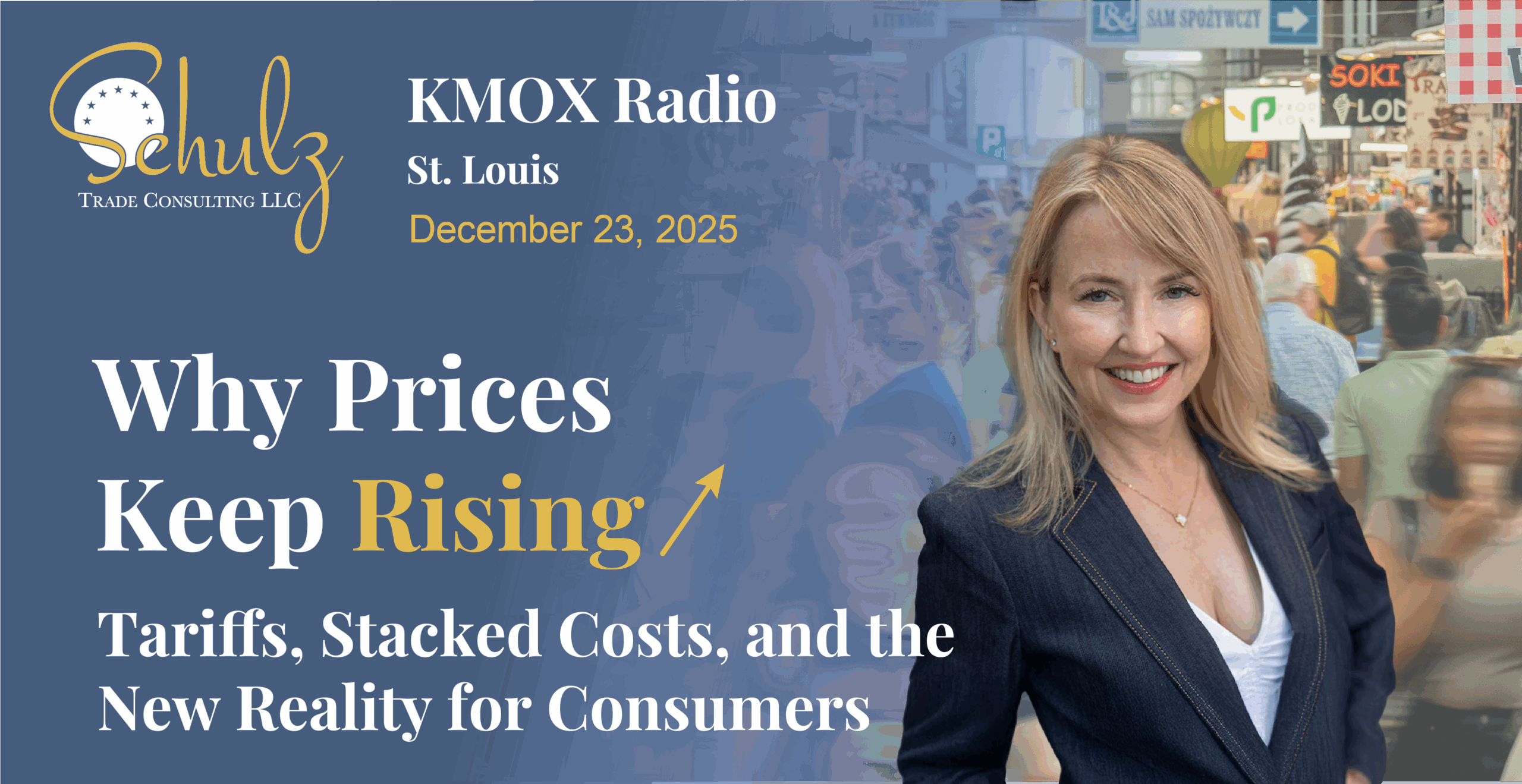
  • Why Prices Keep Rising: Tariffs, Stacked Costs, and the New Reality for Consumers

    Why Prices Keep Rising: Tariffs, Stacked Costs, and the New Reality for Consumers

    Michelle Schulz on KMOX Radio

    Why Prices Keep Rising:

    Michelle Schulz explains how baseline tariffs and stacked duties are driving higher prices—from holiday gifts to cars.

    In a recent interview on KMOX Radio in St. Louis, Michelle Schulz, founder and managing partner of Schulz Trade Law, joined hosts to explain why consumers are paying more across nearly every product category.

    From holiday shopping to electronics and automobiles, Michelle outlined how broad-based tariffs—many of which apply regardless of country of origin—are quietly reshaping prices and leaving consumers with fewer goods for more money.

    knx los angeles logo

    KMOX Radio

    St. Louis

    Hosts: The Chris and Amy Show

    Baseline Tariffs and Why Everything Costs More

    Michelle explained that today’s price increases aren’t limited to a handful of imports or countries. Instead, nearly all imported goods are now subject to a baseline tariff—often starting at 10%—with no minimum value threshold.

    “Imported items have really resulted in hyped-up prices… there’s no minimum, so it doesn’t matter what you’re buying—it might be subject to a tariff.” 

    Even when individual tariffs are paused or adjusted, importers must price goods based on risk and uncertainty. As a result, consumers see higher prices regardless of whether a specific tariff is currently active.

    Modern kitchen with red pots on stove, white cabinets, and bright windows. Shelves with dishes. Neutral tones create a calm atmosphere.

    Which Products Are Being Hit the Hardest

    Certain categories have seen especially sharp increases. Kitchen goods, electronics, clothing, and shoes are among the most affected, with tariffs stacking on top of one another depending on product components and materials.

    “Kitchen goods are up about 38%, electronics about 34%, and clothes and shoes are going up at least 20%.” 

    Michelle noted that electronics often face multiple layers of duties—base tariffs plus additional tariffs on metals like aluminum, steel, and copper—compounding costs long before products reach store shelves. These increases are already showing up in major consumer purchases such as gaming consoles, appliances, and household electronics.

    Confusion, Classification, and Why Prices Rarely Come Back Down

    One challenge for both businesses and consumers is that tariffs are rarely itemized at checkout. Many companies fold tariff costs into pricing without disclosing them, making it difficult to track what’s driving increases.

    “There are different tariffs by product… every product is categorized by a Harmonized Tariff code, and tariffs can stack upon each other.” 

    Michelle also addressed whether prices are likely to fall. While some consumers hope reduced demand will force price corrections, she sees a different pattern emerging.

    “People are spending more, but they’re just coming away with less.” 

    Meaningful relief, she noted, would likely require court intervention—specifically a ruling by the Supreme Court of the United States on the legality of the broad emergency-based tariffs currently in place.

    Aerial view of a parking lot with rows of tightly packed cars. Lines and numbers mark spaces. Cars are mostly black and white.

    Beyond Retail: Cars, Equipment, and Long-Term Impact

    Tariffs aren’t just affecting consumer goods. Michelle highlighted rising vehicle prices, increased scrutiny at customs, and reduced demand for new agricultural and industrial equipment.

    “Tariffs are directly impacting the price of cars… people don’t want the new ones—they want the old, cheaper ones.” 

    As costs rise, businesses and consumers alike are delaying purchases, repairing older equipment, and adjusting expectations—signals of longer-term economic distortion rather than short-term price spikes.


    schulz trade consulting icon

    Tariffs are no longer an abstract trade issue—they affect pricing, purchasing power, and business planning across the economy.

    If your company imports goods and needs clarity on tariff exposure, classification, or cost-reduction strategies, Schulz Trade Consulting can help you navigate today’s trade landscape with precision and foresight.

  • Tariffs, Refund Races, and the Growing Cost of Trade Uncertainty

    Tariffs, Refund Races, and the Growing Cost of Trade Uncertainty

    Michelle Schulz on KCBS Radio

    Tariffs, Refund Races, and the Growing Cost of Trade Uncertainty

    Michelle Schulz breaks down refund lawsuits, Supreme Court risk, and why tariffs aren’t delivering their promised results.

    In a wide-ranging interview on WLW Radio’s Scott Sloan Show, Michelle Schulz, founder and managing partner of Schulz Trade Law, discussed the growing legal and economic fallout from U.S. tariff policy.

    With billions of dollars already collected, major companies racing to secure refund rights, and farmers and importers absorbing long-term damage, Michelle explained why the current tariff regime is creating uncertainty rather than leverage—and what businesses should be doing now.

    WLW Radio

    Cincinnati

    Host: Scott Sloan

    The Race for Refunds and a Legal Bottleneck

    As tariffs continue to generate massive revenue, large companies such as Costco, Revlon, and Ray-Ban have moved quickly to preserve their ability to receive refunds if the tariffs are ultimately struck down. These companies sought to block U.S. Customs from finalizing duty calculations—known as liquidation—to speed up repayment.

    That effort failed. The U.S. Court of International Trade denied a consolidated motion to delay liquidation, setting the stage for a much longer refund process if the tariffs are overturned.

    “If all that has to be refunded, then it does have to be refunded—but we’re going to have to go through a long process to get that money back.”

    Michelle warned that even if refunds are legally required, administrative reality means companies could wait months or years to recover billions already paid.

    Supreme Court Uncertainty and a $130 Billion Problem

    The potential scale of refunds is unprecedented. According to filings referenced in the interview, roughly $130 billion in tariffs has already been collected—and that number continues to grow.

    Michelle noted that while the Supreme Court of the United States initially expressed skepticism about the legality of these tariffs, the outcome is no longer predictable.

    “In the beginning, I thought it was pretty likely the Supreme Court would strike them down… but the more I read and follow the government’s reactions, I think it could go either way.” 

    If the Court invalidates the tariffs after liquidation occurs, importers will still be entitled to refunds—but only through a formal protest process that Customs is historically slow to administer.

    Why Tariffs Aren’t Working—and Who’s Paying the Price

    Michelle also addressed whether tariffs are achieving their stated goals, particularly with respect to China. The data suggests otherwise: China’s trade surplus continues to grow as it expands exports to other regions, while U.S. importers and farmers absorb higher costs and retaliatory losses.

    “Relative to China, we can see that the tariffs really aren’t having the intended effect… China seems to be fine.” 

    Farmers face a double burden: higher import costs for equipment and lost export markets due to retaliation. Subsidy checks, Michelle noted, do little to offset structural damage or restore lost demand.

    At the same time, U.S. companies are increasingly viewed as unreliable trading partners, as sudden tariffs, price renegotiations, and policy reversals undermine long-term relationships abroad.

    What Importers Can Do Now

    Despite the uncertainty, Michelle emphasized that businesses still have meaningful opportunities to reduce exposure. Reviewing tariff classifications, country-of-origin determinations, and—especially—customs valuation can uncover significant overpayments.

    “We’ve had importers overpaying because they were overvaluing their goods… sometimes it’s a technicality, but that technicality matters.”


    schulz trade consulting icon

    Tariff uncertainty isn’t going away—but overpayment doesn’t have to be inevitable.

    If your company imports goods and is concerned about duties, refunds, or compliance risk, Schulz Trade Consulting can help you identify savings, prepare for potential refunds, and navigate trade complexity with confidence.