Tag: consumers

  • The Supreme Court’s “Trillion-Dollar Test”

    The Supreme Court’s “Trillion-Dollar Test”

    Michelle Schulz on KNX Midday News, Los Angeles

    The Supreme Court’s “Trillion-Dollar Test”

    Michelle Schulz on Tariffs, Emergencies, and Executive Power

    As the Supreme Court weighs whether President Trump overstepped his authority with sweeping tariffs, trade attorney Michelle Schulz explains why the stakes reach from Wall Street to Main Street.

    KNX Midday News

    Los Angeles

    Anchor: Brian Ping


    The “Emergency” at the Heart of the Case

    During her interview with KNX Radio Los Angeles, international trade attorney Michelle Schulz explained that the Supreme Court is examining whether President Trump legally invoked the International Emergency Economic Powers Act (IEEPA) to impose tariffs without congressional approval.

    “That was the initial launch of the IEEPA tariffs,” Schulz said. “It was aimed at China, Mexico, and Canada for the fentanyl crisis—which, I don’t know if that’s considered an emergency or not.”

    What began as a narrow policy has since expanded.

    “It then expanded in April to the reciprocal tariffs—those country-by-country tariffs that range all the way from 10% to 50% and continue to be arbitrarily assessed depending on how the executive branch feels about that country.”

    A Question of History and Legitimacy

    Schulz emphasized that this use of IEEPA has no real precedent in modern trade law.

    “Historically, the IEEPA has not been used for this purpose,” she said. “The government argued that President Nixon achieved a 10% tariff under the Trading with the Enemy Act back in the 70s—but that’s not the same thing. That was limited, and that was a long time ago.”

    The conservative justices, Schulz noted, appeared skeptical that a years-long trade policy could qualify as an “emergency.” The ruling could determine whether future presidents retain unilateral power to impose tariffs—or whether Congress must reassert its constitutional authority over trade.

    Economic Fallout and Possible Refunds

    If the Court rules against the administration, Schulz said the results could be both chaotic and beneficial. “

    It could be chaos, but it’s beneficial for importers,” she explained. “U.S. companies are losing money every day because they’re the ones responsible for paying the tariffs. They’ve lost a lot, so if this comes out in favor of the plaintiffs, it could mean a lot of refunds for importers.”

    Those refunds could translate into a short-term boost for businesses and the stock market. As Schulz put it, “

    The government has collected a lot of taxes through these tariffs—but it’s the companies in the U.S. that are primarily paying those. So we’re taxing ourselves.”


    schulz trade consulting icon

    Whether the Supreme Court reins in or reaffirms presidential trade power, the implications will be sweeping.

    If your company has been affected by recent tariffs—or may be eligible for refunds—contact Schulz Trade Consulting today to assess your exposure, prepare refund claims, and develop strategies for navigating future trade actions.

  • Supreme Court Weighs Tariff Power

    Supreme Court Weighs Tariff Power

    Michelle Schulz on KXAN News Austin

    Supreme Court Weighs Tariff Power

    Trade attorney Michelle Schulz joins KXAN Austin to explain how the Supreme Court’s review of President Trump’s tariffs could reshape presidential power—and why small businesses are caught in the middle.

    kxan news

    KXAN TV, Austin


    Presidential Power or Overreach?

    As the U.S. Supreme Court heard oral arguments over President Trump’s sweeping tariffs on foreign goods, international trade attorney Michelle Schulz provided legal context from Texas. The justices are reviewing whether the administration overstepped its authority by invoking the International Emergency Economic Powers Act (IEEPA)—a law originally meant for national emergencies.

    “The plaintiffs include a group of states as well as small businesses,” Schulz explained. “They’re saying that the President’s interpretation of the law gives the executive branch unlimited authority to impose tariffs—and that’s not what the law was intended for.”

    Schulz noted that the justices appeared skeptical.

    “No one ever uses this for tariffs, and it doesn’t say it authorizes tariffs,” she said. “It appears there’s a little bit of a stretch.”


    The Business Impact:

    50% Tariffs and Fading Options

    For many of Schulz’s clients, the debate is not theoretical—it’s financial survival.

    “This impacts not just large companies but also small ones, and we have both contacting us,” she said. “They’re saying, ‘We can’t mark up the price anymore.’ They’ve reached agreements with their foreign suppliers, but most suppliers aren’t willing to take on that legal burden of paying the tariff.”

    Some of the tariffs under review are as high as 50%, which has left many businesses squeezed between rising import costs and consumer resistance.

    “It’s a matter of money and whether they can pass the cost to their clients,” Schulz said. “For some, it’s closing their doors or finding new sourcing entirely.”


    Beyond the Case:

    Manufacturing, Policy, and the Future of Tariffs

    While the administration has argued that tariffs encourage domestic manufacturing, Schulz noted that the reality has often been the opposite.

    “Importers are not able to manufacture because they can’t import the parts and components at a reasonable price anymore,” she said. “Manufacturing jobs haven’t just come to the U.S.—they’ve also left.”Michelle Schulz on KXAN-TV, Aus…

    Even if the Supreme Court sides with the plaintiffs, Schulz warned that tariffs won’t disappear.

    “There are other authorities like Section 232 and Section 301, which cover copper, aluminum, steel, furniture, and pharmaceuticals,” she said. “Those aren’t impacted by this decision. This case only applies to the country-by-country tariffs based on how our administration feels about each nation.”

    schulz trade consulting icon

    Whether the Court narrows presidential authority or upholds it, businesses will still face a complex tariff environment.

    If your company imports goods or components, contact Schulz Trade Law today to review your tariff exposure, explore refund opportunities, and prepare for future trade shifts.

  • Supreme Court Reviews Trump Tariffs

    Supreme Court Reviews Trump Tariffs

    michelle schulz on nbc 5 dfw news
    Michelle Schulz on NBC 5 DFW

    Supreme Court Reviews Trump Tariffs

    Michelle Schulz on What’s at Stake for Texas Businesses

    As the Supreme Court weighs the limits of presidential power, trade attorney Michelle Schulz explains how the ruling could shape refunds, sourcing strategies, and the survival of small businesses.

    NBC 5 DFW

    NBC 5/KXAS-TV, Dallas-Fort Worth

    Reporter: Vince Sims

    The Case Before the Supreme Court

    This week, the U.S. Supreme Court began hearing arguments on whether President Trump exceeded his authority under the International Emergency Economic Powers Act (IEEPA) when imposing wide-ranging tariffs. Speaking with NBC 5, Dallas-based trade attorney Michelle Schulz said the legal question centers on whether the law was ever meant to be used this way.

    “I have never seen it used for tariff leverage before,” Schulz explained. “If I’m honest, I do not believe that it follows the letter of the law.”

    The outcome could redefine how presidents wield economic power—and directly impact businesses across Texas and the nation.

    The Human and Financial Toll

    NBC 5’s story featured Sue Schultz, owner of What’s Poppin Texas in Waxahachie, whose 25-pound boxes of white chocolate jumped $40 per case under the new tariffs. She told reporters she’s tried to keep prices down for her customers, even though it’s squeezing profits.

    For many importers, Schulz said, the financial hit has already been devastating.

    “If the court rules against the President, customs would then owe refunds to our clients—many of whom have lost millions of dollars in revenue.”

    But if the Court upholds the tariffs, companies will have to double down on compliance and logistics reviews.

    “You’ll see more importers reviewing specifics of their transactions,” Schulz added. “Many have already moved their sourcing—and that’s not very helpful.”

    Beyond the Ruling: What Comes Next

    Even if the tariffs are struck down, Schulz cautioned that the administration still has other legal tools available.

    “Even if the tariffs are ruled illegal, the Trump administration has several other options to impose tariffs.”

    For small business owners like Sue, the uncertainty remains daunting. “I’m really hoping they can pull back some of these tariffs,” she said. “They’re hurting the little guy. But once prices go up, I don’t know if they’ll ever really come back down.”

    schulz trade consulting icon

    The Supreme Court’s decision could set a major precedent for trade law and business operations in the U.S.

    If your company has been affected by recent tariffs—or may qualify for future refunds—contact Schulz Trade Consulting today to prepare your compliance strategy and explore refund recovery options.

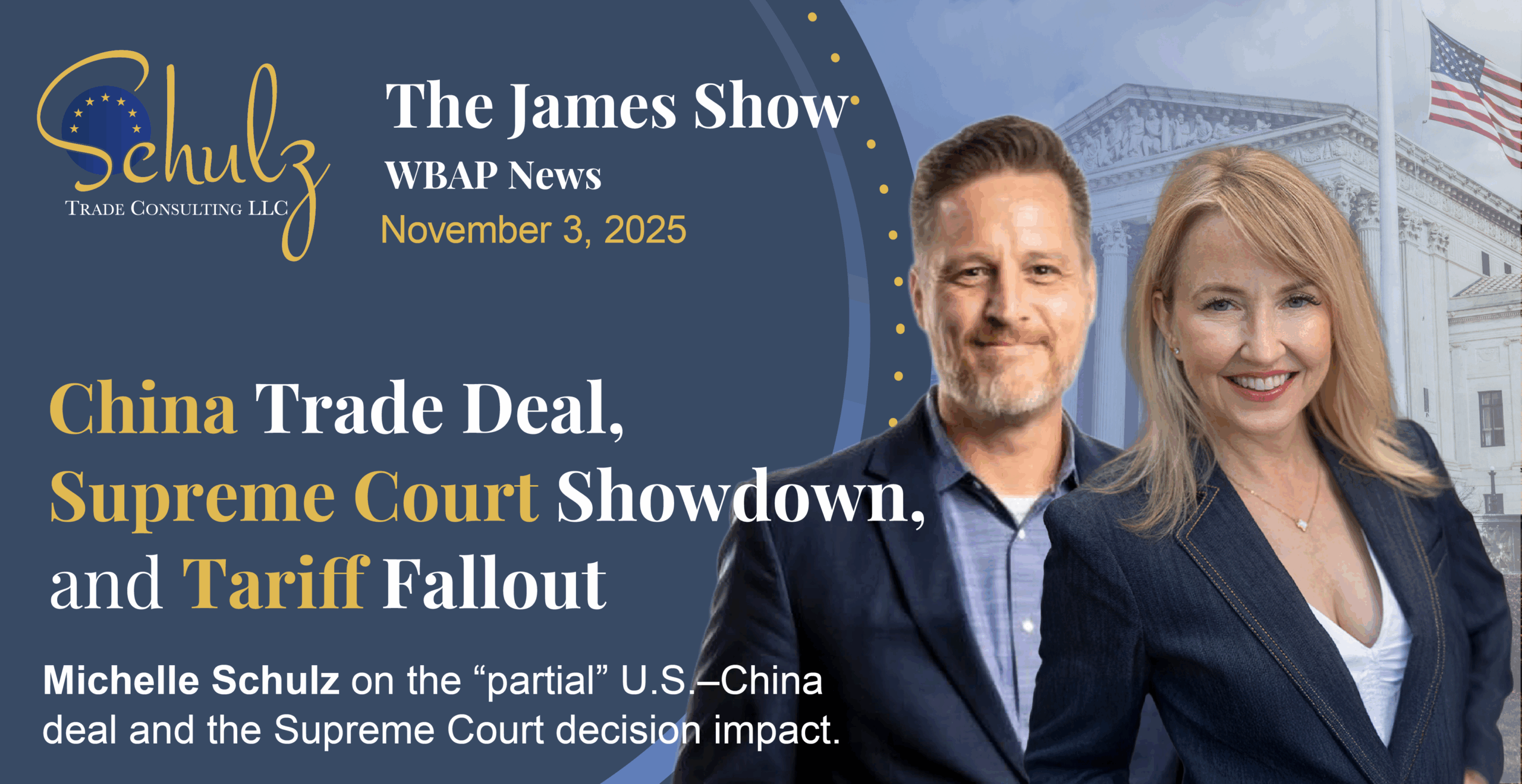
  • The China Trade Deal, Supreme Court Showdown, and Tariff Fallout

    The China Trade Deal, Supreme Court Showdown, and Tariff Fallout

    Michelle Schulz on WBAP Radio

    The China Trade Deal, Supreme Court Showdown, and Tariff Fallout

    Michelle Schulz Explains What’s Next on WBAP Radio

    Trade attorney Michelle Schulz breaks down the “partial” U.S.–China deal, who’s being hit hardest by tariffs, and what the upcoming Supreme Court decision could mean for importers and consumers alike.

    The James Show

    WBAP News

    Host: James Parker

    The Real-World Impact of Tariffs

    Discussing President Trump’s new “partial” China trade deal, Michelle Schulz, founder of Schulz Trade Law, explained that while the administration touts progress, the effects on American businesses remain severe.

    “I represent large companies, importers, and also small and medium-sized importers,” she said. “What I’m seeing is that companies of all sizes are impacted down to the individual. Business owners have contacted me saying, ‘My business is no longer sustainable because the tariffs on my goods are too high, and my customers won’t pay that.’”

    Schulz noted that some sectors—especially apparel, accessories, and small consumer goods—are struggling most.

    “We’ve got companies importing things like clothes and jewelry and shoes that just can’t make it under the current environment.” 

    The Supreme Court

    and the Limits of Presidential Power

    The interview also previewed the Supreme Court hearing scheduled for November 5, where justices will decide whether the President has legal authority to impose “reciprocal tariffs” under the International Emergency Economic Powers Act (IEEPA). Schulz explained:

    “The question is—Is this an emergency, or is this just for leverage? In my mind, the law is clear. An emergency would have to be more imminent harm rather than overall leverage in a multi-year trade war.”

    If the Court rules against the administration, Schulz said importers could be eligible for refunds on tariffs deemed unlawful.

    “Importers would have to go to customs and request refunds on anything that was ruled illegal,” she said. “It’s great for importers, but I wouldn’t expect it to happen quickly.”

    Even with a ruling against the President, Schulz noted that tariffs on steel, aluminum, and other materials would remain—since those were enacted under different laws tied to national security.

    The Long Game:

    China, the WTO, and the Future of Trade

    Looking beyond the immediate legal battles, Schulz explained that China’s long-term strategy remains focused and ambitious. “It’s only a partial deal,” she said.

    “Keep in mind, China’s looking long term—they’re hoping to integrate military and commercial products and have a world-class military by 2049.”

    Even if the Supreme Court strikes down some tariffs, Schulz expects the administration to continue pursuing alternative legal paths.

    “If it’s not an emergency, Trump has already initiated investigations for unfair trade practices and national security under Sections 301 and 232,” she explained. “They’re kind of a ‘Plan B.’”

    As for global recourse, Schulz noted that China could take the matter to the World Trade Organization, but is unlikely to prevail.

    “They could, but I don’t think they would fare well,” she said. “China has a reputation for not following WTO rules.”

    schulz trade consulting icon

    From shifting tariffs to court challenges, the trade landscape is changing daily.

    If your company imports goods from China or other affected countries, contact Schulz Trade Consulting today to assess your tariff exposure, explore refund opportunities, and develop compliance strategies for the next phase of global trade policy.

  • Tariffs Tighten on Furniture and Wood: Michelle Schulz on WBAP Radio

    Tariffs Tighten on Furniture and Wood: Michelle Schulz on WBAP Radio

    Michelle Schulz on WBAP Radio

    Tariffs Tighten on Furniture and Wood

    Michelle Schulz Explains What’s Ahead for U.S. Buyers and Businesses

    International trade attorney Michelle Schulz outlines how new furniture and cabinetry tariffs—rising as high as 50%—are set to increase prices and pressure both importers and consumers.

    WBAP Morning News

    WBAP News

    Host: Ernie Brown and Carla Marion

    New Tariffs Take Effect

    During her interview with WBAP Radio in Dallas–Fort Worth, Michelle Schulz confirmed that the latest round of tariffs is already being felt across the furniture and cabinetry markets.

    “As of Tuesday, the new thing is furniture, wood cabinetry, kitchen cabinets that are imported are subject to a 25% tariff,” she said. “Vanities and associated products also 25%. Furniture and other cabinetry can go up to 50%, and we’re expecting this to increase to 50% for everything by January 1.”

    Schulz noted that the changes are happening fast and may continue to fluctuate:

    “I can’t predict if this will really happen or if this will change again, but this week, it’s happening.”

    Rising Costs and Consumer Confusion

    When asked whether consumers can see the tariff costs reflected in retail prices, Schulz explained that it’s not always transparent.

    “You might see a line that shows a tariff charge—or you might not,” she said. “There’s no requirement that a company show you which part is the tariff. But our clients are hiking up prices because they can’t keep up.”

    With supply chains still strained from earlier trade actions, the combination of new duties and high material costs could make furniture, cabinetry, and home goods even more expensive heading into 2026.

    How Tariffs Are Applied

    Schulz also broke down how tariffs are actually assessed—a common source of confusion among consumers.

    “The tariff is assessed at the time of customs entry,” she said. “Your tariff depends on what the tariff code was for the item at the time of entry. If you import a complete piece of furniture, you pay the tariff on the complete piece. If you’re importing components to assemble here, the tariff is on the components coming in.”

    She added that correct classification is critical: “

    It’s important to understand whether your tariff coding is correct. If it’s not, you could be overpaying—or facing compliance problems later.”


    schulz trade consulting icon

    Tariff classifications, rates, and enforcement are shifting rapidly—and they directly affect your bottom line.

    If your business imports furniture, wood products, or other home goods, contact Schulz Trade Consulting today to review your tariff codes, ensure compliance, and identify cost-saving opportunities before the next round of increases.

  • Tariffs on Cabinets, Drugs, and Metals

    Tariffs on Cabinets, Drugs, and Metals

    Tariffs on Cabinets, Drugs, and Metals

    Michelle Schulz Explains What’s Coming October 1

    Trade attorney Michelle Schulz unpacks why tariffs are targeting everyday goods, how drug prices may rise, and what consumers and manufacturers should expect in the months ahead.

    September 29, 2025

    KSL News Radio

    Salt Lake City, Utah

    Inside Sources
    Host: Holly Richardson

    Listen:

    Why Cabinets and Vanities Are on the List

    When asked why the administration would target something as specific as kitchen cabinets and bathroom vanities, Michelle Schulz explained that the choice ties back to trade imbalances.

    “Over the past five or six years, we’ve seen a lot of tariffs on cabinetry and wood items from China and Vietnam. These goods are flowing into the United States much faster than they’re flowing out. So the 50% tariff is intended to address that deficit.”

    This reasoning highlights how tariffs can sometimes focus on niche categories where the U.S. sees a widening gap, even if the products are central to ordinary households.

    Drug Costs and Uneven Impacts

    Turning to pharmaceuticals, Schulz pointed out that the effects will vary depending on the size of the company. Major players like Roche and Novartis—already operating in the U.S. or pledging billions in investment—may avoid the harshest penalties. But smaller and mid-sized firms face a much tougher path.

    “My concern is more with the medium size or smaller businesses. They probably cannot afford to open a manufacturing plant that quickly in the U.S., and they have to commit by October 1.”

    For consumers, this could mean higher prices at both the pharmacy counter and in prescription drugs. “Anything with a brand that is on a shelf at a pharmacy is going to go up. And similarly, prescription drugs are not ruled out.”

    Metals, Trucks, and the Consumer Timeline

    The new tariffs also extend to aluminum, steel, and copper—all at 50%. Schulz noted this could affect everything from beer cans and soda to industrial containers. Even heavy-duty trucks will face a 25% tariff, though she admitted imports in that category are less common.

    As for when consumers might see benefits from these policies, Schulz was cautious:

    “I don’t expect the benefits to come quickly, because they virtually never do in these situations. First, we’re going to see the negative impact… maybe a year or two from now, we might start benefiting. But as of today, this is customs collecting revenue from U.S. companies, and that revenue goes to the government.”

    schulz trade consulting icon

    With October 1 approaching, companies need to know exactly how these tariffs apply to their goods—and whether investments or commitments can shield them.

    Contact Schulz Trade Consulting today to review your supply chain exposure, assess compliance risks, and prepare your business for the long-term impact of these new trade measures.

    Trade on, but trade informed!

  • Tariffs on Films, Drugs, and Trade Authority

    Tariffs on Films, Drugs, and Trade Authority

    Tariffs on Films, Drugs, and Trade Authority

    Michelle Schulz on SiriusXM POTUS Politics

    Trade attorney Michelle Schulz unpacks the legal battles over presidential tariff authority, the unusual push to tax foreign-made movies, and the real-world challenges businesses face under shifting trade rules.

    POTUS Politics

    SiriusXM Radio

    The Briefing with Steve Scully
    Host: Steve Scully

    Listen:

    Tariffs on Films: A Legal and Practical Puzzle

    Michelle Schulz addressed one of the more unusual tariff proposals—placing a 100% duty on foreign-made films. She explained that applying tariffs to movies is far more complex than with traditional goods.

    “Typically, when we’re looking at tariffs, we have to determine what percent is originating in the tariffs country… but here we’re talking about services, not goods.” 

    She noted that customs would need to develop rules of origin for films and determine how to value them, possibly requiring later reconciliations once fair market value can be calculated.

    Schulz emphasized that with today’s global film production—from Canada and Great Britain to India and Italy—the question of whether a movie counts as “foreign-made” is both technical and unresolved.

    Presidential Authority and the Supreme Court Showdown

    The conversation quickly turned to the broader legal context. At issue is whether the president has constitutional authority to impose tariffs without Congress.

    Schulz reminded listeners that two lower courts have already ruled against the administration, finding that tariffs should be under congressional authority. “

    “Congress should be involved in the assessment of tariffs according to the Constitution… but we’re kind of not seeing it, which is very confusing.”

    The Supreme Court, set to hear arguments in November, will decide two central questions: whether trade deficits constitute an “emergency” under the International Emergency Economic Powers Act, and whether the president can use that authority to implement sweeping “reciprocal tariffs.”

    As Schulz explained,

    “That was not what the law was originally designed for back in the 70s.”

    Business Realities: Who Pays the Price?

    Beyond the legal wrangling, Schulz highlighted the burden on companies being asked to move production to the U.S. “You can’t turn on a dime and create a plant,” she cautioned.

    Even firms willing to break ground face zoning laws, permits, and long timelines. In practice, she noted, the companies that benefit most are large players like Roche and Novartis, which already operate U.S. facilities and have committed billions in investments. Smaller and mid-sized businesses, however, are far more likely to face ongoing penalties until they can prove compliance.

    “It’s certainly much more complicated than just saying we’re going to break ground and build a plant for X number of employees,” 

    Schulz concluded, underscoring the real-world gap between political announcements and business feasibility.

    schulz trade consulting icon

    The debate over tariffs is not just a political fight—it’s a compliance challenge for businesses across industries, from pharmaceuticals to entertainment.

    If your company needs clarity on how shifting U.S. trade laws affect your operations, contact Schulz Trade Consulting today for guidance on risk, enforcement, and strategy in an unpredictable trade environment.

    Trade on, but trade informed!

  • Tariffs, National Security, and Rising Costs

    Tariffs, National Security, and Rising Costs

    Tariffs, National Security, and Rising Costs

    Michelle Schulz Explains What’s Ahead

    Trade attorney Michelle Schulz breaks down the new wave of U.S. tariffs on drugs, furniture, and trucks—explaining the legal backdrop, economic timing, and global implications.

    marketplace logo

    September 26, 2025

    LIVE Now

    Fox News

    Host: Mike Pache

    Watch:

    Why Tariffs Now?

    The Supreme Court and a Backup Plan

    As the U.S. prepares to impose new tariffs on October 1—ranging from 50% on pharmaceuticals to 30% on furniture—Michelle Schulz explained that timing is no coincidence. A critical Supreme Court case in early November will determine whether “reciprocal tariffs” are legal.

    Schulz noted that this new package of tariffs seems to act as a safeguard.

    “In my view, this is kind of a backup plan, because these would have to be implemented under a different law… under Section 232, where investigations are conducted into national security.”

    National Security Justifications and Consumer Impact

    Traditionally, Section 232 investigations have applied to defense-sensitive materials like steel and aluminum. Extending that logic to kitchen cabinets and upholstered furniture struck Schulz as unusual:

    “Couches, furniture… it’s a little interesting. I know the President has mentioned that we’re flooded with foreign-made furniture, but I don’t know how that connects with national security.”

    At the same time, she emphasized the very real impact on U.S. consumers. With the de minimis rule—allowing imports under $800 without duties—recently eliminated, prices are already climbing.

    “It’s kind of a turning point, because products are going to be noticeably more expensive now, and I think consumers will notice.”

    Global Responses and the Road Ahead

    International partners are watching closely. While the EU and Japan claim to have secured limits on U.S. drug tariffs, Schulz warned that these are not yet solid agreements.

    “There has been an agreement reached with the EU, but it’s not fleshed out yet. We have these letters and broad terms, but not full-on free trade agreements.”

    Pharmaceutical giants like Roche and Novartis are pledging major investments in the U.S., but smaller companies may struggle. As Schulz pointed out,

    “Tariffs can stack on one another… I wonder what will happen with companies that are smaller, maybe in other countries that can’t afford to build plants in the U.S.”

    schulz trade consulting icon

    With tariffs shifting rapidly and enforcement intensifying, businesses need to stay ahead of both legal and economic risks.

    If your company is navigating these changes, contact Schulz Trade Consulting today to assess your exposure, review compliance strategies, and prepare for the Supreme Court’s decision.

    Trade on, but trade informed!

  • Tariffs, Trade Shifts, and Business Uncertainty

    Tariffs, Trade Shifts, and Business Uncertainty

    Tariffs, Trade Shifts, and Business Uncertainty

    Michelle Schulz on SiriusXM POTUS Politics

    Schulz Trade Law founder Michelle Schulz breaks down how U.S. tariffs are reshaping global trade, what “handshake deals” really mean, and why businesses are struggling with enforcement and volatility.

    September 25, 2025

    POTUS Mornings

    POTUS Politics

    SiriusXM (Channel 124)

    Host: Tim Farley

    Listen:

    China’s Global Pivot Amid U.S. Tariffs

    Michelle Schulz explained that while the U.S. is imposing steep tariffs on Chinese imports, China has adapted by redirecting its exports to other markets. Instead of losing ground, China has strengthened ties with developing economies and the BRICS nations.

    “China has been just shifting its exports mainly to other parts of developing Asia, but all around the world, heavily to Latin America… essentially headed to a $1.2 trillion trade surplus, higher than last year’s.”Michelle Schulz on SiriusXM POT…

    “We’re kind of cutting off China, but we’re seeing China just go make other friends… this is what I’ve seen over the past 20 years, where the U.S. tries to impact China, and China just jumps and works around us.”Michelle Schulz on SiriusXM POT…

    The Reality of Trump’s “Deals”

    President Trump and administration officials have touted new deals with foreign partners, but Schulz cautioned that these are not the same as formal trade agreements. Unlike the detailed negotiations behind agreements like USMCA, many of these current arrangements are vague and lack enforceable details.

    “These deals are much less formal. Sometimes they come in the form of only a letter, and they’re not detailed… not dense documents that address rules of origin or labor laws. They’re mainly basic agreements that haven’t been fleshed out yet.”Michelle Schulz on SiriusXM POT…

    The Confusion and Cost for U.S. Businesses

    For U.S. companies, the ever-changing tariff environment has created a storm of uncertainty. Businesses face confusion, price hikes, and growing risks of penalties from enforcement agencies.

    “Businesses operating in the U.S. are… confused by the volatility and constant changes. Every time policy shifts, the U.S. businesses have to shift.”Michelle Schulz on SiriusXM POT…

    “Some companies don’t know what to do, and they’re working on marking up their prices to fill the gap. In some cases, tariffs can be higher than 100%.”Michelle Schulz on SiriusXM POT…

    “U.S. Customs and Border Protection is heavy on enforcement… penalties can be as high as two or three times the duties that are owed. In some cases, you end up owing more than the goods were even worth.”

    Hear more on POTUS Politics, SiriusXM

    schulz trade consulting icon

    This shift isn’t just disruptive—it’s a call to action for smarter importing. 

    At Schulz Trade Consulting, we’re at the forefront, helping clients calculate duties, navigate USMCA exemptions, and mitigate risks in this new era. Reach out to us for tailored trade compliance strategies.

    Trade on, but trade informed!

  • E-Commerce in Turmoil: Michelle Schulz Warns of Seizures and Scams in Marketplace Feature on De Minimis Changes

    E-Commerce in Turmoil: Michelle Schulz Warns of Seizures and Scams in Marketplace Feature on De Minimis Changes

    michelle schulz in marketplace article
    Michelle Schulz on Local Live News

    E-Commerce in Turmoil:

    Michelle Schulz Warns of Seizures and Scams in Marketplace Feature on De Minimis Changes

    What to know about online purchases now that Trump has ended the de minimis exemption

    The end of a shipping loophole means that packages under $800 are subject to duties. That’s created chaos for consumers. 

    Trade War 2.0 by Janet Nguyen

    As the dust settles from President Trump’s July 30, 2025, Executive Order suspending the de minimis exemption globally—effective August 29 for non-postal shipments—consumers and businesses are grappling with a transformed landscape of online imports. This move, which accelerated the exemption’s repeal from its original 2027 timeline, has led to shipping suspensions from major postal services and a sharp drop in low-value imports, echoing the 75% plunge seen after China’s exemption ended in May.

    De Minimis Changes

    In a Marketplace article published September 10, 2025, our founder and managing partner, Michelle Schulz, cuts through the chaos. Janet Nguyen’s piece explores how packages under $800 now face duties, punitive tariffs under the International Emergency Economic Powers Act (IEEPA) ranging 10-50%, and even 50% rates on items like steel and aluminum.

    Michelle Schulz highlights the stark realities for shoppers:

    “I think people are going to realize that if you order something online, you might not even get it. Customs has said if the correct customs duty is not paid, they will seize it.”

    She also reveals the exemption’s prior scale—4 million daily shipments tumbling to 1 million post-China ban—and flags emerging scams via text messages falsely claiming tariff debts.

    The article breaks down tariff calculations (percentage-based via the Harmonized Tariff Schedule or flat fees like $80-$200 for six months), shipping options (DDP for seller-paid duties vs. DDU shifting costs to buyers), and red flags like demands for wire transfers or Social Security numbers. Experts like Derrick Kyle of Torres Trade Law and Courtney Griffin of the Consumer Federation of America emphasize verifying fees, retaining records, and disputing unreasonable charges to avoid collections or package destruction.

    schulz trade consulting icon

    This shift isn’t just disruptive—it’s a call to action for smarter importing. 

    At Schulz Trade Consulting, we’re at the forefront, helping clients calculate duties, navigate USMCA exemptions, and mitigate risks in this new era. Reach out to us for tailored trade compliance strategies.

    Trade on, but trade informed!